Popular Posts

Sunday, December 26, 2010

When words fail

In the all-too-brief visit to my home congregation in Adelaide, fresh from the zeal and excitement of beginning theological study, I receive the sobering news that one of my congregants (with whom I had formed a warm relationship over the past few years) has effectively been handed a death sentence: palliative care. Cancer treatments have failed, and all that is left is the waiting for the inevitable end.

Oh please, can we not do this?
His attendance at last Sunday's service required a Herculean effort, though I did not know it at the time, to honour the relationship we had formed, by attending. I feel unworthy of this, and had I known, I would have begged him to forebear.

Ministers jokingly refer to the "rites of passage" function of our work as the "hatch, match, and dispatch department." It's a blithe way of filing events of emotion and mystery and great significance so we don't have to take our role in them too seriously, and avoid the crushing sense of responsibility that comes when people actually NEED us to AD-MINISTER these passages.

The hatch and the match can be "diarized" around other commitments, and are negotiable and non-urgent.

The dispatch, however, is nobody's poodle. It comes when it will and you need to be ready to drop things and just be there for the people in your charge. And, in cases like this one, where you know and love the departing, you have to wrestle your own grief and sadness and sense of impotence into a firm choke-hold, so that the engagement doesn't become all about you.

People most need religion, it seems, just like they most need poetry-- that is, when the usual order of life drops away, and the abyss is glimpsed.

For all the keyboard-jousting I've been doing, for all the libraries chock-full of theological texts I've been gorging on, for all the jumping-through-verbal-hoops I'm called to acrobat--what USE is any of it, in the face of what Phillip Larkin calls:

... the total emptiness forever,
The sure extinction that we travel to
And shall be lost in always. Not to be here,
Not to be anywhere,
And soon; nothing more terrible, nothing more true.

And how does a minister comfort one facing this without the customary blandishments of "God" or "Heaven" or "Eternal life"?


This is a special way of being afraid
No trick dispels. Religion used to try,
That vast moth-eaten musical brocade
Created to pretend we never die,
And specious stuff that says no rational being
Can fear a thing it cannot feel, not seeing
that this is what we fear - no sight, no sound,
No touch or taste or smell, nothing to think with,
Nothing to love or link with,
The anaesthetic from which none come round.

So, failing an appeal to child-like faith, can stoicism be any real comfort? Brave words, after all, are just words.

Most things may never happen: this one will,
And realisation of it rages out
In furnace fear when we are caught without
People or drink. Courage is no good:
It means not scaring others. Being brave
Lets no-one off the grave.
Death is no different whined at than withstood.

I see now that the month I spent at my dying father's bedside in 2003 changed me utterly and forever, and constituted a second puberty, a rite of passage, for me. For all the false hope and happy talk that went on around him that month, we all knew what was coming. He knew I did not share his bog-Irish Catholic faith, and to his credit he did not ask me to pray with him or for him, though I would have, and without a nano-second's hesitation, if I thought it might comfort him. But he knew me better, and this showed he loved me better than I loved him, and I loved him a lot.

In the end all I could do for him, as he drifted in and out of consciousness, was to be there, quietly witnessing ('with-nessing'), suffering it with him, in what I can only call 'solidarity'. In the end, words failed. Much of his conscious time, we just held each other's hand, and I can feel his calloused palm now in mine as I type this sentence.

If this is what is wanted, I can do this, and an age of theology cannot teach it. Solidarity with suffering has to be learned (what cannot be taught can still be learned) by bitter experience. It took me a month with a dying man I loved to move from false hope ("surely God will save him") to silent witness (Mary and Mary Magdelene weeping at the foot of the cross, powerless). That he was my father intensified the urgency, made me learn it quick.

What were they thinking, back in the day, when 20-something, fresh-faced young virginal males were the preferred ministerial livestock? What in that time could they have suffered? What could they have known about counselling, say, the bereft, or the couple locked for years in bitter marital strife? No wonder churches got a reputation for being staffed by irrelevant, dreamy, bookish bird-brains.

Butter could not melt in that mouth

Every time I complain about how old I'm getting, I need to remember that if this work is worth doing, I actually NEED the aches, pains, losses, scars, and open wounds I carry from a half-century of living on this 'b*tch of an earth' (as Beckett put it).  All the dark stuff we enshadow to make ourselves look so capable and invulnerable--the doubt, fear, and despair we keep constantly at bay--is precisely what gives us solidarity and communion with our fellow beings. It is easier to feel closer to someone like Larkin, who puts all this out there, tells his secret terror of death, than to someone like, say, Donald Trump, who has evidently never had a moment's self-doubt (even about that absurd comb-over of his).


Sir, your mortality is showing...

In fact, now that I think of it, Trump's combed-over quiff is an excellent emblem of the armour of persona, the shiny shop-front we construct to meet the world that doesn't want to hear about our fears and failings and mutability. All such constructed selves are usually absurd, swept as they are over phrenologically lumpy underside writhing with demons of mortality and decay. As more hair falls out and the lumps begin to show, more hair spray, more elaborately concupiscent blow-waves are needed to hide the awful truth--and the construct gets stranger and stranger.


Such a natural look-one of the many faces of denial

In an age of Berlusconi's hair-transplants (which he denies), Clooney's nip'n'tuck (which he admits), and washed-up rock-chicks' collagened lips (looking for all the world like a transplant from Nemo), we have never in human history been in greater denial of aging, and the only end of aging.  There is nothing more mutable than the flesh, but you wouldn't know it. We seem to have lost the knack of aging gracefully, in full realisation and acceptance of the life cycle. Perhaps this is because no-one any longer believes in heaven, and the idea of fitting your INNER life for the next world seems pointless.


You can always tell the age from the hands, they say.

If this is IS all there is, it's hard to argue with that ethic. But notwithstanding all the glossy surfaces, "to this end must we come" as Hamlet said, and the dying man I will sit with today is having to weigh all this--fear, faith, doubt, meaning, purpose--and in that grapple, it's good to have someone in your corner, ready with the water and the towel, a witness without words, to "ad-minister" some comfort.

The "ad" part means "to the other". Let me not forget that today.

Solidarity forever.

Post-script: news today that my friend has passed away, Christmas morning. I had visited him two days earlier, and the fore-going was written around that visit.

In accordance with his wishes, I have been asked to conduct the memorial service. Past suffering now, he goes ahead to discover the great mystery. I will do my best for those of us who remain and will miss him.

Tuesday, December 14, 2010

Some assembly required--notes toward a pre-Christmas address

Congratulations on your purchase of the new Christmas 2010, Millenium edition! Once assembled, it will give you 12 days of shiny, fluffy service, creating rosy nostalgia that will long outlast what you ever intended!


Please ensure that the following parts have been included:

Parts list:

12 months a-paying off credit cards

11 cards from people you’ve never met.

10 metric tonnes of shredded wrapping paper

9 unwrapped bottles of undrinkable wine

8 hours whiled away a-tv watching

7 9-volt batteries needed

6 buttery puddings

5 useless things!

4 maiden wickets

3 invitations declined

2 hours at church

....and Her Majesty’s Christmas address!


Assembly instructions:

Step 1: Fold ‘goodwill toward men’ into 'peace on earth'. Note: this may require the use of force.

Step 2: Insert token incarnation of God into large corporate-profit-driven consumer orgy.

Step 3: Screw financial solvency.

Step 4: Hold ever-dimming fragments of nostalgic Christmas memories in your hands. Do not worry if they dissolve like wet cake in the rain. This is normal.

Step 5: Join these fragments of memory together with lashings of exotic foodstuffs and liberal amounts of drink

Step 6: Place well to the back of your mind the nagging sense that you should be giving all this money to charity and spending time working a soup kitchen

Step 7: Nail Samaritans' number directly above phone.

Step 8: Wipe with clean soft swaddling cloth and lay in manger. (Avoid contact with livestock if planning to travel.)

Please discard packaging responsibly. Or in the Coles parking lot dumpster.

Congratulations! your Christmas 2010 millennium edition is now IN-complete.

(If for any reason you are not completely happy with your purchase, contact one of our service centres for support. Note: due to factors beyond our control, response times may vary up to, well, eternity.)

Friday, December 3, 2010

"Haggling over the price"

Churchill (drunk) to Socialite: "Madam, would you sleep with me for a million pounds?"

Socialite to Churchill: (thinks a moment) "Why of course, Winston."

Churchill to Socialite: "Madam, would you sleep with me for 10 pounds?"

Socialite (outraged): "Of course not! What do you think I am?"

Churchill: "We've established what you are; now we're simply haggling over the price."


The story may be apocryphal, but it sure sounds like him.


As I write this, Derek Jacobi, one of the greatest classical actors of his generation, is featured in a series of UK TV ads wherein he plays Ebenezer Scrooge in order to shill Sony electronic products for Christmas gifts. This, while he prepares form a national tour of King Lear.


Why oh why did he not choose a dignified retirement?

Also during the silly season, Dame Helen Mirren cheerfully spruiks Wii Fit for Nintendo. Apparently it keeps her the fit GILF she is widely reputed to be. And she never needs to leave the house to do anything so common as join a gym.

What next, the Ab-swing?

John Malkovich features along with Clooney in an ad for Nescafe instant coffee. They both look a litle embarassed.


One imagines their lives are actually a lot like this.

These are a just a few examples. The list goes on.

All actors do ads. But you'd think you'd get to a certain level of success, or wealth, or notoriety, or at least self-respect to be able to turn demeaning dreck like this down.

I have a pretty good idea of what they'd say to this carping--"Oh yeah? Do you have any idea how much they're PAYING me to do this? I'd have to run Lear for ten years before I made this kind of money. You, son, are just jealous no one wants to give YOU a millions quid for an ad. Or for anything. Grow up."

The depressing thing is that there just no longer seems to be an answer to this sort of logic anymore. Ads pay well; money's what it's about. Too much of it is never enough. There's always another chalet, another island, another private jet to buy, or whatever. A buck's a buck.

 I mean, I know if you do a film, you're essentially fattening up the bottom line for some multi-national conglomerate, that's just part of the game. But getting in front of a camera, and charming poor in-debt slobs out there in a major recession to buy more junk they don't need with money they ain't got? And doing it only because it makes you more stratospherically rich than they? Is that what you spent years honing your talent, developing your career, giving up the easy blandishments of a normal life for? Is this finally, what you've come to?

Have you, finally, no sense of shame?

I've been trying to think of great actors that never sold anything, never became a corporate shill, not once, not ever. I'm struggling...Any suggestions?

I've done ads, but had no noteworthy and respected career to foresake or to cheapen by doing so. Yes, they paid insanely well, totally disproportionate to any "acting" involved. I once made 12 grand over two years just for showing up on a given day, eating french fries, and doing one smirk to the camera. I do the smirk at parties now. I call it "my 12 grand look". There were many others, some better paid, and none of them worth the money I was getting. This is where the real dough is in the acting game.

Mamet called acting "A whore's profession", and this sort of thing makes it easy to see why. I used to get the standard question from casting agents: "Is there anything you wouldn't advertise?" 

"I draw the line at land mines," I used to joke.

But I think we both knew that if the check were big enough, that qualm might be sorely tested. Toward the end, I refused anything connected with drink or gambling or the financial sector--in Australia, this represents quite a lot of commerce. And if you're going to have scruples that discount advertising obvious social ills, you might as well quit. Which I did.

I don't claim moral credit for this, and the Catholic in me suspects that the stains on my conscience will not wash off as easily as the make-up did. Once you take money for something you know to be disgraceful, your soul dies a litte bit, and like brain cells, the bit that dies never comes back.

For, once upon a time, and not that long ago, I looked squarely into my soul, and saw that if the money was right, I'd have f***ed Churchill too.

The horror. The horror.

Monday, November 29, 2010

A humanist Advent poem (with commentary)

After Isaiah

How we have hurried toward this time of waiting,
Head-long to this fully fallow stretch of days!
We pick the calendar’s windows’ dating,
Keeping vigil at the stubble-field’s lowering haze.


Gone the days of full-bellied harvest,
Gone as surely as the sun goes west.


How we gorged on the fruit of the vine.
How we wrung the windfall from the tree.
And wolfed the blood-warm lamb, cut fine,
And sopped the juice with loaves we gathered, free.


Now the sun slung low across this field of time
Sheds milky light on furrows, tumbled clods.
Even steeple bells seem muffled when they chime,
Above a land laid waste, abandoned by the ancient gods.


This is “the sign you shall be given”: longing, dearth.
Below the spent, expectant, sulking earth,
The hidden powers shift and knit and surge;
Burgeoning life awaits in womb, as soil and soul converge.

***

This was the result of a creative writing assignment meant for one of my MA classes. It was intended to be written to be part of an advent liturgy within the context of my denomination. Originally, I thought it might be an invocation, given at the beginning of the service. However, after reflection and discussion, it's probably too rich a pudding to start the meal with. It could probably work as a reading.

It was seeded by a couple of words: "waiting" and "fallow". It was fertilized with a passage from Isaiah 7, something about a 'land laid waste' and 'a sign will be given unto you'. But the sub-soil is all TS Eliot's "The Wasteland" and Keats' "To Autumn". The 'feel of the words in the mouth' owes a lot to Seamus Heaney.

We'd been seeing a lot of countryside lately, fields plowed into furrows or stubbly with chaff. It occurred to me that the bleakest time must be this long after the harvest festivals of September, when the feasts have been eaten and all that's left is what you smoked, salted, dried or pickled. The land won't yield for a long time yet. The "sign" we're given in the run-up to Christmas, then, is the bleakness of mid-winter. The world saying: "expect nothing from me." But there's always something cooking, deep down and unseen...

A few technical points. The second stanza is intentionally short to create the sense of something abruptly stopped. The "Gone" repetition is meant to be the chimes referred to in the third stanza, but I think it might be too far away to have that effect. The religious imagery in the third stanza is intentionally eucharistic: loves, wine, blood of the lamb, and the 'tree of life'.

I wanted more uplift in the last stanza, more a sense of something gathering force, hence the throbbing rhythm. Ah well... I'll leave it for now. But my tutor, Rev. Dr. Andrew Pratt, is interested in working with me to make it a hymn. He's only written about 600 or so.

That, I'd like.
You have to want to see it

Wednesday, November 24, 2010

Eff-ing the ineffable

"We keep saying God is ineffable--but we keep on eff-ing him!" --Don Cupitt

You've probably heard the old Buddhist story of the Blind Men and the Elephant? If so, skip down a bit.

If not, here's a jokey Victorian poem that puts it neatly (read it aloud, enjoy the bouncey meter):

It was six men of Indostan
To learning much inclined,
Who went to see the Elephant
(Though all of them were blind),
That each by observation
Might satisfy his mind.


The First approach'd the Elephant,
And happening to fall
Against his broad and sturdy side,
At once began to bawl:
"God bless me! but the Elephant
Is very like a wall!"

The Second, feeling of the tusk,
Cried, -"Ho! what have we here
So very round and smooth and sharp?
To me 'tis mighty clear
This wonder of an Elephant
Is very like a spear!"


The Third approached the animal,
And happening to take
The squirming trunk within his hands,
Thus boldly up and spake
"I see," quoth he, "the Elephant
Is very like a snake!"


The Fourth reached out his eager hand,
And felt about the knee.
"What most this wondrous beast is like
Is mighty plain," quoth he,
"'Tis clear enough the Elephant
Is very like a tree!"


The Fifth, who chanced to touch the ear,
Said: "E'en the blindest man
Can tell what this resembles most;
Deny the fact who can,
This marvel of an Elephant
Is very like a fan!"


The Sixth no sooner had begun
About the beast to grope,
Then, seizing on the swinging tail
That fell within his scope,
"I see," quoth he, "the Elephant
Is very like a rope!"

And so these men of Indostan
Disputed loud and long,
Each in his own opinion
Exceeding stiff and strong,
Though each was partly in the right,
And all were in the wrong!

So oft in theologic wars,
The disputants, I ween,
Rail on in utter ignorance
Of what each other mean,
And prate about an Elephant
Not one of them has seen!
--John Godfrey Saxe ( 1816-1887)

Any resemblance to an actual Elephant is entirely accidental

What's interesting to me in this story is the omniscient point of view of the narrator. He knows there's more to the elephant than those with less sight have seen. He's not blind, and sees the whole of the WHATness of the elephant entire.

Problem is, we're not him and no one else is either. We're all the blind, and there is no omniscient narrator to instruct us on the folly of our ways. It's tempting to say that in matters theological, the blind lead the blind, and that the theological project is to spin ever more elegant and compelling analogues between, say, the SPEARness of the spear and the TREEness of the tree.

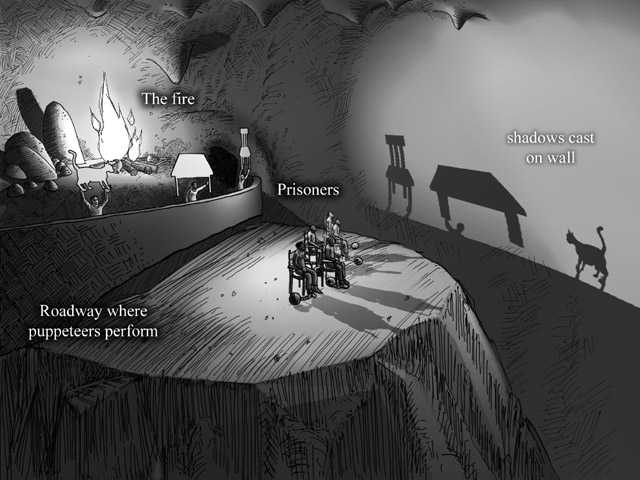
The story uses 'seeing' as an analogue for engagement with the true nature of an object, and reminds me of Plato's Myth of the Cave, wherein chained captives mistake shadows of objects for truth of the object itself. From this, Plato gets his notion of "forms" the ideal things which are most true ("horseness" is the form of all horses, etc.).

"No, no, no! Since they all have four legs, they must all have a common nature!"

At the heart of this approach is an assumption about what we mean by truth--that when our descriptions CORRESPOND well to the nature of the thing itself, we have truth. But if we can't ever actually get at "the thing itself'--that which is beyond our experience--how can we measure how well our descriptions match the actual nature of things?

There are approaches to truth other than this correspondence theory. Most of our theological training seems to take the COHERENCE model--that is, how well our descriptions fit other descriptions that have been found reliable in the past. It's easy to see the weakness in this 'house of cards' approach, where each questionable description relies on other questionable descriptions and the whole rickety structure can be brought down if just one part is thrown into doubt.

Oh the humanity!

Neither of these approaches are entirely reliable. "What is truth?" asked jesting Pilate, a question especially difficult when we're trying to "eff" the ineffable. I suppose all theology is predicated on faith, which St. Paul calls "The substance of things hoped for. The evidence for things unseen."

If belief is the only criteria for approaching the ineffable, the trouble is you can believe anything--fairies in the garden, Big Foot, junk bonds. "I believe I'll have another gin-and-tonic" is about the extent to which I'm willing to rely on belief alone. But if not belief, and not correspondence, and not coherence--what, then?

Absolutely general skepticism about the world looks challenging, but it's really not. Unless you're absolutely mad, you don't live as though nothing can be reliably known. We trust, for example, the authority of science, when we could not possibly verify scientific claims with our own senses and intellect. We thus take on faith things like the Big Bang, the speed of light, sub-atomic physics. I'm sure there are a few people that thoroughly 'know' these things which are otherwise ineffable to us, but I don't know any, and so that sort of knowledge remains a sealed, gnostic priesthood of the few.

Why not admit that we take most of what we think we know absolutely on faith? That my wife loves me, that my daughters are really mine, that my house is a sound investment, that certain acts like charity, mercy, pity, temperance, are good in themselves? Maybe I'm utterly wrong about one or more of these. Maybe what I take to be truths as solid as a spear, tree, or a rope is REALLY something utterly other and beyond my ken?

I believe I am eff-ably happy.

We can only do the best we can, blind as we are, seeing 'through a glass, darkly.' Work needs to be done. Children need to be raised. The garden needs tending. Every day you get up, and get on with things, is an act of pure faith.

I can eff that.


Tuesday, November 16, 2010

Mock the Yank: Or, "it's not paranoia when everyone's out to get you"

I recently passed my 25th anniversary as a ex-pat. So that's nearly half my life making a home, a life, careers, and networks in other countries, namely the UK and Australia.

When people learn this, they nearly always express surprise that my accent hasn't changed. My standard response to this is to bore the socks off them by pointing to research in developmental psychology indicating that once you hit a developmental threshold at around the age of 15, you pretty much have to want to change it. Before that age threshold, accent is soaked up by a kind of codependent osmosis of 'fitting in". When my older daughter Kate spent a year in Australia as a 12-year-old, it took only a few months for her to pick up the laconic drawl.

After that threshold, you have to make yourself do it. Think of Mel Gibson's mid-career morph from Mad- Max drawl to flattened Californian in the Lethal Weapon series, the better to advance his career in the USA. If you know any adult who, in adulthood, acquired an accent, there was some reason they wanted to do it, and had to work at it for a while. This requires a sustained act of will.

yankee as apple pie

So in my case, it may just be laziness. In Australia, working as an actor, there was financial encouragement to remain the token Yank, as it pretty much sewed up a niche market I alone could fill. Never mind the talent, feel the authenticity of the vowels. However, if I'm honest, there's more to it than laziness and self-enrichment.

Especially in Australia, since 9/11, I have often longed for my accent to vanish. I became a lightening-rod for local anti-American sentiment. This took many forms, and usually said more about the interlocutor than about geo-politics. A guy mowing my lawn said he  had "a bone to pick with me about that Rupert Murdoch of yours." It was no good telling him that Uncle Rupe was an Adelaide newspaperman. No, no, once you become a US citizen, that's it.

yankee as a meat pie

More often, though, confrontations took the form of "you yanks are all alike", like whatever the negative judgement was. If you demonstrate self-confidence, it's typical American arrogance. If you express enthusiasm about something, it's typical Yankee showmanship. If you vigorously argue a point, you are a fascist. If you succeed at something, the game was rigged. If you fail at something, there is barely concealed glee. You get the idea.

For a while, in the wake of the Bush-era foreign policy insanity, I felt like a spent my life apologizing around the world on behalf of my birth-country, at pains to point out that there were many of us who voted democrat, opposed war, were outraged by the curtailment of civil liberties, appalled by the use of torture--the the things that filled the headlines in those dark days. New people i'd meeet would find out where I was from, and they'd pull an intake of breath, gearing up to recite the litany of our foreign policy offences, and I'd have to beat them to it: "Look, yes, I'm sorry, I know. It's horrendous. It's not me they represent." And so on.

As yankee as a pie full of wet rocks

Now, you'd think that a theological college would provide a safe haven from anti-American prejudice and stereotyping. But you'd be wrong. In the two months I've been here, the "small pond' has only amplified prejudice (as in pre-judging one's character--an American is necessarily like thus and such) and stereotyping ("spoken like a true American"). As if any person is MERELY determined by factors beyond their control--colour, birth-country, gender, etc. I suppose I shouldn't be surprised: ministers and aspirants are only human, and prone to the same us-and-them reflexes as everyone else. But it is dis-spiriting nonetheless.

"Anti-americanism is the last acceptable form of prejudice." Discuss.

All of these reminders of my "radical otherness" reinforced my alienation from whatever country I lived in, worked, in, paid taxes in, raised my kids in, had my being in. Had adopted BY CHOICE, not chance.

So why not adopt the local accent and short-circuit the confrontation, stereotyping, blame, and alienation? It's not like I didn't have the voice skills. I could have done it easily.

Thinking about this, I can see three reasons that may account for this apparent masochism. First, hanging onto my accent is just about my only through-line to my past, my only link to my origins. Maybe this is fear, that I'd be so un-moored without it, I'd lose a sense of self. Second, choosing to sustain my 'radical otherness' give me an 'outsider' perspective that I've relied on in my writing, teaching, acting, and preaching. I enables you to offer people new ways of looking at things, and that novelty of perspective is in itself different, interesting, educative, and thus valuable. Third, otherness indulges a personal taste for dialectic, and this is not always helpful (see the post "Leading with my chin" below). You can disrupt comfortable, reflexive views of things and thus create the conditions for conflict. As a life-long, gigantic sissy, I actually hate arguing and just want everyone to get along and play nice.

"A man reaching his fiftieth year is more certain than he was at forty that he now possesses more past than future." (--James Lander, Lincoln and Darwin: Shared Visions of Race, Science, and Religion)

Given this hard truth, how do I want to live the remaining years? Go back the the US and finally, finally just "blend in" again? Is that even possible, given an adult life spent doing the opposite? Can you ever really go home again?

Three passports=belonging nowhere?

Or continue to plow this rocky furrow--a man without a country, a stranger in a strange land, offering to the locals the strange and exotic fruit of that labour?

Stay tuned, friends.....


As Yankee as a...umm...doodle?

Friday, November 5, 2010

On why I appear to be a feminist theologian

Of all the theology I've read in the past two months, and that's rather a lot, no theories or "schools" have struck such a major-key chord with me as has the feminist theology of Mary Grey. (Let me assure you if you're outside such discourse, that her work has nothing to do with deciding which gender God is.)


Funny how people you've never met can 'speak' to you.

Maybe it shouldn't be so surprising. After all, I'm married to an academic with some considerable professional form as a feminist, am the father of two daughters (for one of whom I was a single-parent dad for many years--see the August post "So much depends on a crappy old bike"), and have been fortunate enough to number many strong, independent women among my close friends for most of my life. In touch with my feminine side? I'd have to say, more or less, yes I am.

So the soil was fertile to begin with. But as you, dear reader, will know, much of my reflexive response to Christo-centric theology has been characterized by resistance, rebellion, and subversion. To a mind trained philosophically, many theological arguments offer a "target-rich environment" of false dichotomies, questionable premises, and subtle evasions. But a purely rational approach, as I am becoming aware, is essentially an arid pursuit. No theology of, say, suffering, is ever going to wholly satisfy, unless you accept the premise of a detached God's essential goodness. To me, that's far from demonstrable, so maybe we need to look at divinity from a more remote perspective, one that compasses creation and destruction a la the Hindu gods, and the ultimate purpose of our suffering so far beyond human understanding as to render it a "mystery", which is in any case, where we start from. "Take it on faith," we are told.

In my own feeble and un-informed attempts to deal with the problem of suffering (in addresses to my congregation in Australia), using only the human tools of philosophy, grass-roots experience, and reflection, it seems that I unwittingly struck on themes which Grey takes up in the work I've been reading. In my address, "Eating Dirt", I reflected on why a God worth worshipping would visit such suffering on the innocent, in particular on the people of Haiti through the recent earthquake, people who were already reduced to eating "mud cookies" to stay alive.


In a cruel irony, the collapsed buildings, lacking any costly structural reinforcement, were shaken into their constituent dirt, and buried the occupants in that dirt, filling their mouths (and ears, and noses, and eyes) yet again. It seemed to me that, while the earthquake itself was an 'act of God' (or nature if you prefer), the deaths were largely an act (or lack of action) of man. These deaths were evidence not of a cruel or indifferent God, but of the broken and distorted relationships between people and nations that so reduce fellow humans to such grinding penury. Global corporate capitalism, colonialism, exploitative and abusive patriarchal 'governments', and international indifference to severe, endemic poverty right on the doorstep of the most affluent cultures in the world.

One of the key elements in Grey's theology is "right relationship'; that is, the task of realising God's work as truly our own in creating full, nourishing relationships--inter-personal, social, ecclesial, and political. Certainly how Haiti got to be more vulnerable to an earthquake than a country with decent infrastructure has a lot to do with its colonial history, corporate exploitation of its resources, and the indifference of its neighbors. In Grey's terms, these are all conditions that grow from traditional patriarchal relationship--dominance, exploitation, treating 'equal' human beings as a means to an end. Right relation, nurturing the full worth of every person, is reflected in traditional maternal values and the essence of Jesus' life and teaching. Right relation, an immaterial energy rather than a concrete entity, may then be understood as the very presence of God. We come to know God in relations of self-transcending love. The kingdom of God is not so much in each of us, as kind of between us, in the shared dimension of mutually nurtuing relationship.

The vulnerability that necessarily happens when risking relationship is he subject for another entry, but is no less fascinating and urgently real.

I can think of at least two other addresses where I explore the same theme of suffering in different contexts. But moreover, it has been those times in my life where I have been most sure of the divine presence, have been in moments of self-transcending love in all its forms--eros, philos, you name it. "The awful daring of an moment's surrender that an age of prudence can never retract" as Eliot said.

But it's more than discovering that I've unknowingly endorsed such theological views--"ah! I see her theology is meaningful because it perfectly accords with my own." It's that it also has wonderful internal coherence, which defuses and resolves troublesome and conflicting dichotomies of spirit/matter dualism. (This is perhaps a subject for another blog entry, and more technical, but take it from me!)

So internal coherence that resolves many of the logic problems of other theologies, plus an accordance with my own lived experience, equals a compelling theology (for me at least), and it gives me joy to be able to say that. As to whether is corresponds to the way the universe is actually set up, who can say? But for once, I don't care if I can say or not. The proof comes in the living of it.

FLASH: Even as I write this in my miserable room in a cold, wet, alien Manchester, the fireworks from Bonfire Night are bursting outside, in full view of my window over my laptop, filling the room with extravagant light in an insanely joyous display that mirrors how I feel having written this, having finally found something to say YES to rather than "no". (The video gets good around 25 seconds in. The timing of this moment is proof of something, but I'm not sure what.)


Right relation? Love? An end to the aridity of pure Reason? Feminist theology?

Yes, I said Yes I will YES!