Popular Posts

Sunday, February 27, 2011

They pitch horseshoes, don't they?

There's a lovely joke doing the rounds on Unitarian message boards and social-networking sites at the moment. It's been around awhile, but there's nothing like a new context to give a joke new life. A true story, apparently...

An American scientist once visited the offices of the great Nobel prize winning physicist, Niels Bohr, in Copenhagen. He was amazed to find that over Bohr's desk was a horseshoe, securely nailed to the wall, with the open end up in the approved manner (so it would catch the good luck and not let it spill out).


The American said with a nervous laugh, "Surely you don't believe the horseshoe will bring you good luck, do you, Professor Bohr? After all, as a scientist..."


Bohr chuckled. "I believe no such thing, my good friend. Not at all. I am scarcely likely to believe in such foolish nonsense. However, I am told that a horseshoe will bring you good luck whether you believe in it or not."

Bohr was neither a bore nor  a boor.

***

Okay, it's chuckle-strength rather than weapons-grade humour. And the moral seems (to me at least) to be about open-mindedness, and a gentle rebuke to the closed dualism inherent in most discussions of science vs. faith.

'Boorishness' may be described as what happens when one analyzes a joke. However, after my ribs stopped being tickled by this, I had the distinct feeling there's more to this joke than meets the ear.

Essentially, this is a humorous application of  Pascal's wager. Substitute the unknowable 'luck' in the story with the unknowable 'God', and you get this:

Only the top left quadrant is value-positive; it's the pie in the sky when you die. I remember being enthralled for a long time by this neat schema. But look more closely:

1. Top right: arguably you haven't 'lost nothing'. You've wasted time and energy (and perhaps the respect of secular friends) by doing things like going to church when you could've been in bed reading the papers, or trying to lead an upright, moral life rather than, say, running Ponzi-schemes, or donating to charities rather than using that cash for cocaine and fast cars and chorus-girls.


Waste of a good cigar...

2. Bottom left: you're screwed. Forever. Your rebelliousness with your hedonism has been an exercise in futility. Hope you enjoyed its brief tenure, 'cause now comes the wrath of the almighty.


3. Bottom right: you were right all along! Well done, thanks for playing. Now you get to be smug with yourself while worms eat your face (though, of course, you won't know it). Perhaps a life of smug self-content is the best you can hope for?


BUT--all the above is predicated on a binary choice between NOTHING and a VENGEFUL God, one who will open a big can of whoop-ass on you for not believing in him. Which has always sounded a trifle insecure to me. A generous God who forgives is not in this formula. (But that's a different discussion...)

Not so, the horseshoe! The horseshoe either does or doesn't bring you luck entirely independent of whether you believe it does or not. It operates on the higher plane of its own terms, and doesn't require your belief to make it effective.

Bohr's horseshoe, like Pascal's wager, says: 'it makes sense to hedge your bets'. Which is fine, UNLESS IT'S YOUR JOB TO SELL HORSESHOES.

The seller can't be personally held to account for the efficacy of luck. How would the horseshoe owner know whether it was the horseshoe itself that brought them luck? By the same horseshoe logic, I could say I believe my coffee mug repels wild hyenas. Do you see any around? Presto! That'll be $5.95, please...

For that matter, does one always recognise luck as luck? After all, not everything which hurts is bad for us, nor is everything which feels good, good for us. Since there's no way to tell, why not buy the horseshoe? Why not hedge your bets?


Go on. You know you want it...
But turn the question around to consider agency: why SELL the horseshoe? Horseshoes can be bought without being 'sold', after all. People can hear of their possible efficacy and seek them out for themselves. If it's a good product, it should sell itself, no? Then, it is the buyer that has the agency in the process. Surely this is a more respectful stance.

This is why I'm reluctant to hard-sell belief in God. I can make no promises for the efficacy or accuracy of belief in the product. If I did, being dead presents the sternest injunction to anyone seeking to get their money back. I can never be held to account, and this is the condition of the charlatan throughout the ages.

I can only speak for myself, and while I'm not superstitious, I'd have no problem with Bohr's horseshoe on my wall. It would represent, for me, not superstition, but a frank admission of the limitations about what I can know. If that's good enough for Neils Bohr, it's good enough for me.

Just don't ask me to sell it to you.

Wednesday, February 16, 2011

Well I'll be frocked...

"I say beware of all enterprises that require new clothes, and not rather a new wearer of clothes."
--Henry David Thoreau, Walden 

"Clothes maketh the man. Naked people have little or no influence on society."
--Mark Twain 

To frock up or not to frock up,
That is the question.

Can anyone help me with this conundrum? The norm amongst Unitarian ministers  in the UK is to 'frock up' in some sort of clerical vestments, and I've been willing, even eager, to fit in with the new context I find myself in out of respect to accepted local practices. When in Rome...

Heck, as a former actor, I actually LIKE dressing-up and costume and all that. You do weeks of rehearsal on a character, but it never comes together (at least for me) until the first costume run, wherein the clothes you wear begin to determine how you move, how you hold yourself, and so begin to work from the outside in, giving shape to what had so far been an unfinished portrait. Any man who doesn't normally wear a tie will just feel rather different when he slips one on. It's hard to know how to handle yourself in a board-room if you're wearing board-shorts. You know what I mean.

even being hacked to pieces, nothing says 'butch' quite like leather
Partly out of necessity, my default choice so far has been to use a borrowed academic gown. But it also suits me (phnar, phnar) because it's a relatively lo-fi option, thrown over a conservative suit. More hi-fi options abound around me--everything from the black-suit-and-dog-collar through to rather glam tailor-made cassocks (in seasonal colours), modest stoles with our "flaming chalice" branding on them, and blingy stoles with a collector's lot of all the world's religious symbols from the ankh to the yin-yang. To each his, or her, own.

Have we left anyone out?
 The borrowed academic gown (with optional institutional hoodie) is, I have learned, a trace symbol of Unitarian reaction against the established C of E set, usually posh, Oxbridge educated. There was a time when to be a member of a dissenting church meant you could not attend such institutions of higher learning, and suffered other class-based oppression as well, some of it physically painful. In short, it's a brisk two-fingers up to the ruling elite, as if to say "See? We're just as smart as you."


Would sir like to see something more off the shoulder?
 Which strikes me as rather pathetic now that I think about it--defining yourself by what you're opposed to rather than what you affirm. Don't get me wrong, I'm all for class-consciousness of the oppressed, but this protesting-too-much has the whiff of an inferiority complex about it. And we have nothing to feel inferior about. On the contrary, Unitarianism is not for sissies.

On the other hand, I've always thought of us as 'low' church rather than 'high' church. No smells, no bells, no iconography, no expensive vestments, and thus no sense that the pastor in the pulpit (him or her up at the holy end) was any different in kind from you in the pew. Put robes, collars, stoles on him or her and suddenly there's class again, a sense that the minister has been inducted into some highly selective gnostic priesthood that allows the wearing of special clothes. Not at all like you in the pew.
Now that's just GAW-jus...

When I think of the ministers who've most influenced me, I see guys in a blue blazer and tie, perhaps with a little lapel-pin logo, looking for all the world like your 10th grade English teacher. It wasn't what they wore, but what they said from the pulpit and did in the community that generated whatever moral authority they had. Mark Allstrom in a blazer and his disreputable black jeans. Roger Frith, blue blazer and khakis. Robbie Walsh, his quietly understated grey hop-sack suit. Jo Lane and her retro-yet-tasteful op-shop dresses and scarves.

You know...like these guys.
The more I frock up to lead services, the more I feel like I'm playing a part, that this isn't really me somehow. I caught a glimpse of myself the other day in the vestry, and there I was-- a sort of horribly miscast yankee Mr. Chips flapping about the playing fields of Harrow, a target for pity and pitched jaffas.

If he's so smart, why isn't he driving a Lexus?
What is all this frocking up, but an attempt to co-opt an ecclesial authority we've never claimed to possess? Were I to wear the dog-collar-and-black-suit ensemble, I would be indistinguishable on the street from a Catholic priest, and God bless them and all, but I really don't want to be mistaken for one. Why would a Unitarian even want to be? If you want to look like a priest, then be a priest. Or a vicar or whatever. Whence comes a drive to slip easily into an appearance of authority, unless you're deepest fear is that you ain't actually got it? And if that's what you fear, no amount of dressing up will ever convince you, deep down.

The difference is, he makes this look good.
Maybe it's all the years spent preaching in the no-nonsense, DTE, GSOH Adelaide church, but I think we're trying just too hard here, and being more true to the antiquarian letter of our past than to its essential spirit--egalitarian, non-conformist, de-mystifying religion in the post-enlightenment world. Class envy runs deep though, so I doubt it will change just because some blow-in newbie mounts a case against the urge to frock up.

I accept that maybe this is just about me and my comfort zone, and that my reluctance to change may come off as intolerance. But I honestly think  I've given it a fair go, tried it on, and on reflection I just can't wear this stuff with integrity. And if you're going to stand up every week and speak your truth from your core, you'd best feel at peace with yourself.
While we're at it, why not go the whole pooch?

Monday, February 7, 2011

A thirty second ad that features the death of a man's soul

I know my moral revulsion at the incorrigible shilling of actors is becoming something of a hobby-horse.

Readers new to this blog may want to refer to the earlier posts ("Haggling over the price" and "What, and give up show biz", parts 1 and 2) for a better developed, considered, and slightly more articulate treatment of the issue.

The following spluttering, inchoate fury I'm about to unleash, was a result of this Groupon Superbowl ad, which, in case you missed it, is linked here. You really need to see it to believe it.

I worked with Tim Hutton on one of the last films I did. We each played the respective fathers of the two young Capulet/Montague lovers. Bizarrely, he, the American, played an Australian farmer, and I, the nominal Australian, played an American exec. But that's show biz.


This publicity shot may prove prophetic

I can't say I got to know him well. He kept himself aloof in a Hollywood-star-not-mixing-with-the-locals kind of way. But reflecting on it now, I think this actually was shame. Here he was, from a venerable Hollywood acting family, having done some great work (Taps, The Falcon and the Snowman) reduced to a supporting role in a low-budget, foreign location vehicle for Alexa Vega. His was meant to be a 'featured support'--you know, where one's name ends up at the end of the title credits after the gravitas-laden "and...".

There are all sorts of reasons established actors do gigs like this. Maybe he just liked the script (not likely). Maybe it was part of a multi-film deal his agent cut and pasted together (plausible). Maybe he knew the director's father (which was entirely possible, as the director was about 12). But thinking about the project now, and seeing this ad, I can only think he needed the work and wasn't in a position to be fussy.

Or thoughtful. Maybe he thought the ad was trying to be knowingly ironic about conflating the political plight of Tibet (one of the largest crimes against humanity in our lifetime) with crass yankee multiculturalism about interesting new cuisine. You know, the kind of dim-witted cozy liberal view that multiculturalism is cool because it means you can have a choice of dozens of international taste sensations at your local food court. Maybe they were trying to send that up.

But it just comes off crass and callous, and the Tim Hutton whose career was eclipsed by his 80's co-stars Tom Cruise and Sean Penn (each respectively in the aforementioned films), should have the ear to discern that. And if he does have the ear, why did he take a gig so obviously tasteless?

Superbowl ads are renowned as an art-form in themselves, and as hugely expensive in terms of air-time, and hugely profitable in terms of audience reach. So it's hard to escape the conclusion that Groupon simply found his price.

I started this rant promising moral outrage, but at this point of writing I just find it sad. He'd've been paid so handsomely that there'd be no need to do low-budget Australian flicks (at least for a few years) and slum with the local talent. A buck's a buck, and there is just no answer to that logic anymore.

But if you look at the ad again, and look at his eyes during the delivery of the crass segue line, you might see what I do, a fleeting sense of "Oh, well, what the hell..." and that right there is where you actually see the man's soul die. Now that's entertainment.

Director Adam Cook, as witty a fellow as ever you're likely to meet, used to joke about collective nouns for actors and directors. A "sneer" of directors,  a "whinge" of actors. And we laughed because these reflected part of the truth of our shared experience of both.

But I now propose a new collective noun for actors of Tim's ilk: a "shill" of actors. Whaddya think?

Monday, January 31, 2011

The Columnist Manifesto

Every once in a while, it's good to remind yourself why you're doing what you're doing.

For example, what are the purposes of this blog?

A way to answer that might be to ask: what might be the purpose of any blog?


  1. Efficiency. If the geography your 'social network' extends beyond people you see everyday, it's simpler to let your friends, family, and colleagues know what's on your mind through a regular post than to write 100 emails or air mail letters. Who, other than the progeny-free, the unemployed, or the fully retired has that kind of time on their hands?
  2. Development of thought. As the 140-character tweet and/or the 160 character sms and/or the (?) character Facebook status update have conspired to lower the bar to new depths of shallow, blogging allows the longitude and latitude to opine, to ramble, to meander to the extent that allows the reader to (in the words of Kurt Vonnegut, literary icon and Unitarian) 'meditate with the mind of another'. The cryptic tweet or update is, by contrast, a come-one line in a noisy bar; it is a hook without a fish dinner in mind. The blog is dinner, dancing, love-making, and pillow talk in the wee hours. You  can get to know people better.
  3. I can think of, oh, a thousand reasons....
  4. Interactivity and community building/maintenance. Though most of my readers' comment on this blog's Facebook link, the blog provides the opportunity for further development through ready discussion--a kind of asynchronous conversation. Emails can do that too, but see #1 above. Plus, readers can talk to each other and develop their own conversation streams and interactions. Emails can't do that.
  5. Rough-drafting and peer review. If you write for a living, as I now do, you write and edit and re-write and maybe show things to your partner or a friend for feedback. But everyone knows that they're going to massage the truth a bit for the benefit of the relationship. This can take many forms--pretending to be interested, turning a blind eye to your hobby-horses or verbal quirks, etc. They're in the echo-chamber of your ego, more or less, and will probably not attempt to scupper the project. So, as with school essays, your mom is not your best critic. Admittedly, the blog is "narrow-cast" (vs. broadcast) to the limits of your social network, but there are varying levels of intimacy in that sphere. Hence, some might point out things that may seem permissible or 'hidden in plain sight' to those closer to you. Further, there's always the chance that those you've never even met may read and offer an even more remote perspective. So, a blog can be a way of airing and developing work you're writing for another forum--in my case, papers, addresses and print articles.
  6. Freeing speech. Because of the low entry requirements (a computer, a broad-band connection, and rudimentary computer literacy), anyone can say anything they like. There are no gate-keepers to bar access to an audience or edit what you say.  Because there is no hierarchical organisation validating and monetizing the blog, any audience you get is one you've built through social networks, through tag words that people randomly Google-search, or just through luck and word-of-mouth. Which is why you're reading this for free. And, while I'm not talking to very many people, no one can shut me up.

So, given those advantages, why would I want to keep THIS blog?

My friend Jane says blogging is verbal wankery, and I can see her point, though there's nothing particularly wrong with pleasing oneself. As Woody Allen said, it's sex with someone you love.

So is it just a self-absorbed exercise in a fruitless dissemination of words into the yawning world wide maelstrom of blather, a drip in the cyber ocean?


But if YOU've read this far, if ANYONE's read this far, what has happened is that you and I are just that tiny bit less alone. And I know from analysing my reader stats (the blogging equivalent of googling yourself) that I am being read in such unlikely places as Spain, India, Canada, The Netherlands, Nigeria, Russia and Germany. How else could THAT have happened?

Near the beautiful climax of the Frank Capra film "It's a Wonderful Life", the unlikely angel Clarence tells the mind-blown George Bailey, overlooking the desolation of his home-town as it might be had he not lived: "Strange, isn't it? Each man's life touches so many other lives."

No man is alone, if he has readers...

We never know the good we may do. We never know what seeds we scatter may find the odd broken patch of vulnerable soil, take root, and transform to flourish in the sun, somewhere.

IF you've read this far, thank you.

Tuesday, January 11, 2011

Bowling for Arizona

Mark David Chapman couldn't punch his way out of a wet paper bag, but he could pull a trigger.

David "Son of Sam" Berkowitz would lose a kick-fight with my daughter, but he could pull a trigger.

Jared Loughner: tough-guy and patriot
Jared Lee Loughner would run home cryin' to his ma if you b*tch-slapped him in the face, but he could pull a trigger.

Any spaghetti-limbed, weak-kneed, addle-pated idiot can pull a trigger.

As my birth nation digests yet another vile serving of violent hate crime, everyone's looking for a single cause, yet the silence about the relevance of the second amendment if deafening. Drafted when the US was an oppressed colony of a greedy, bullying empire, the second amendment to the constitution grew from this context of armed resistance to foreign occupation. That context has utterly changed, but hanging onto the guns acts as a kind of feedback loop, where the deadly implements re-instill the paranoia that caused their adoption 200+ years ago.


It's not the word of God, folks. It was written by guys who owned slaves and used buckets for toilets.

The on-going presence of these 'tools' shapes us. Discuss.

A gun is not just different IN DEGREE from knife or a club. It is different IN KIND. Someone with a knife or a club 5 feet away from you cannot seriously hurt you. You can run from them, but not from a bullet. A bullet changes the dynamics of violent interaction. With another implement, say a knife, your hand and arm have to register the crunch and squelch of flesh and sinew and bone. Ever tried to cut a whole, raw chicken into pieces? With, say, a club, your hand and arm have to register the thud and splintering sensation. There are strong evolutionary inhibitors to these sensations when another human is on the end of them, close enough to gasp their breath in your face, close enough for you to see their eyes roll back in their sockets. Killing with bare hands or held implements is hard work, too. It takes time and persistent effort. Guns are the A.D.D.'s best friend: quick, gestural, detached.


Careful: this thing's loaded

If the kids at Columbine had come to school armed with baseball bats, most, if not all, of the victims would be alive today, and having their own families. Discuss.

The solution posited by gun-totin' types goes like this (sung to the tune of "Dixie"): "Oh, I wish the kids in the school had guns, too, they coulda fired back and yell "yahoo", Fire away! Fire away! Fire away, NRA!"

I kid you not. The patriotic answer is to arm everyone, cause if guns are outlawed only outlaws will have guns. (Which might make them easier to spot, but well...). Suppose congresswoman Gifford, and all the victims (including the 9-year old girl), and for that matter each and everyone at that rally had been packing heat when Loughner started shooting. Yes, Loughner would probably be dead, but in that miasma of panic and confusion, how do you tell which of all the armed people around you are not accomplices, and therefore require a round or two in the face? Result: bloody anarchy for a few minutes and many corpses.


A handgun is a tool with only one purpose, and if you say 'target-shooting' you are an idiot. What do you think the targets are proxies for? The concealability of the handgun is but further evidence of cowardice. Did Loughner--or anyone EVER--mosey down the street with a deer rifle in plain sight? No. Why? That would be advertising your intentions, which is to produce the weapon when no one expects it, hence the cowardice. Only a handgun will do the trick.

"Dr. Freud! Calling Dr. Freud!"

Have you ever held one? I have--Glocks, Colts, S&W's, and even a WW1 Webley--and each and every one of them felt--what is the word for it?--sexy in the hand. The tool is crafted to grip easily, is molded to the shape of a human hand, and feels like a powerful extension of yourself. That sensation embiggens the smallest man effortlessly. This is their principle attraction, and it's hard not to see psycho-sexual implications for men in holding an empowering tool in your hand. Which leads me to the entirely plausible conclusion that hand-gun-play is for the sexually frustrated or disempowered male. "What a stud I am! Blam! Blam! Ba-blam!"

My Dad was a relatively sweet and peaceful man who had succumbed to the cultural paranoia of gun ownership. He did not hunt. He did not sport shoot. Yet he owned three firearms, two of which were concealable:  a Mauser automatic, and a S&W 'Saturday Night Special' six-shooter. He also bought a pump action 30-0-6 shotgun from a fellow at the plant. These were to 'defend the house' in case would-be burglars came a-callin'. The fact that we, having nothing, would not have been high on anyone's burgling list did not come into the equation.

When he was showing his new bargain shotgun purchase off to my sister one day, he casually pointed it at the ceiling as though tracking a doomed duck through a marshland. And blew a hole in the ceiling you could fit a basketball through. Seems the safety was not on.

That'll buff out...

It was a testament to his DIY skills that he got up into the loft and patched and painted the hole before Mom got home, which would mean hell-to-pay. You'd never know it was there. It is also a testament to my sister's discretion that I only found out a few years ago. She had been sworn to secrecy. But had my sister's sweet, beloved face been in the way that day, well...that would be the sort of thing a family never gets over and poisons generations yet unborn with guilt, remorse, shame, and terror.

So--now the paranoid patriot's nightmare: mobilize the national guard and confiscate every last one of the wretched, seductive, lethal things, and melt them down, and turn them into a wind-farm. Just a thought.

Repeal or significantly change this vile, out-dated, contemptible statute, before any more 9-year-old kids get holes blown through their chests.

Present on the fateful day due to an interest in, of all things, politics.

Postscript: for visualized data on gun crime in the USA go to: http://www.guardian.co.uk/news/datablog/2011/jan/10/gun-crime-us-state

Sunday, January 2, 2011

Coming Home to 'The Bite'

Anyone who is unable to ackowledge the deep cultural mythology in sport simply isn't looking.

Baseball at Cooper's Oval
Friends of mine have a hard time understanding my love of baseball, the 'national pastime' of the land of my birth. It is played from the bright promise of spring through hazy humid golden summers through to the hard realities of autumn. At its core, is a powerful yankee myth--that one's team scores by coming 'home'. Home: after a statistically unlikely launch onto the base-paths, after navigating one's way from safe base to safe base. Home after going 'round the horn' of the field. It is the hero's journey in a peanut shell.
Quincey Lattimore, a young prospect from North Carolina, safe at home
This myth is framed in sepia-toned nostalgia for days when all one had to do was play ball, when the home our parents kept loomed large and beckoned with kitchen smells at the end of a day of play in the sun, and the drowsy rituals of bath and bed, sunburnt and exhausted and clean and fed. Safe at home!


"...until they think warm days shall never cease"
And never more happy to be safe at home am I this holiday season, during which, to my giddy delight, the fledgling Australian Baseball League is off the ground again November through February. These months bound the "off season" in the Northern Hemisphere, and to these sunny shores come hungry young players affiliated with pro teams, to work on their game, many on their way to a shot at "The Show" and big-money contracts.


Jamie McOwen from Miami Florida, his eyes on the prize
Some come from college baseball, some from the minor leagues (the A and AA mostly), and more than you'd think come from the Korean and Japanese leagues. Some even come from small but impassioned baseball sub-cultures as far afield as India and the Netherlands. These professional hopefuls are teamed with the best players from the Australian amateur leagues, and the result is a standard of play that, while not exactly at the elite level, certainly rewards  a leisurely walk to Cooper's Oval, a few blocks from my house.

There, for $12, you can sit behind homeplate and watch every pitch, something only the very rich get to do back in the US of A. With the backing of local sponsors, Major League Baseball, and the Australian Baseball Academy, money has been spent, and the popularity is growing--several thousand watched a recent game at the oval, to cheer our local team, the Adelaide "Bite" (geddit?).

Okay, maybe the worst team name ever
To say this does my old heart good, doesn't come close to how blissful it feels to watch the game's leisurely rhythm and occasional heart-stopping drama, as the sun sets behind the gum trees and the twin domes of a church, with its white stucco and its domed spires, looking for all the world like the Alamo. And to do so in the company of my wife and/or daughter and/or close friends who indulge what must seem to them an alien practice. But it's summer, and in a variety of ways, I'm 'at home'.


Field of Dreams
And at home, last night, watching players far from home on their journey as hopeful itinerant players, I saw an Indian pitcher zipping 80 mph fast balls to a young Korean batter, neither of whom are in any sense "of" the cities they represent for the enjoyment of fans. The whole league construct is made-up, a means of feeding Australian and international talent into the machine of a multi-billion-dollar industry. Although there are long-standing baseball subcultures in nearly every large Australian town or city, the roots do not go wide into the Australian soil. Nor do the roots of this made-up league go as deep as, say, Australian Rules Football, one of the world's most demanding and least-appreciated sports.

Once this game gets hold of you, it does not let go. It holds a special place in my memory, of course, and not because I ever any good as a player. It's been heartening, for example, to hear kids from the local little leagues at the oval, swapping a Manny Ramirez for a Greg Youkilis baseball card, or talking about how the Dodgers look good for next year. Obviously, it has colonised them good, and visions of a big-money contract in the "states" no doubt dance on the horizon of their dreams. A few Aussies have had good careers in "the bigs"--Gary Nilsson, Grahame Lloyd, to name a few, and hopefully this made-up league can make that happen for a few more.

But in the end, and not to invoke Field of Dreams too much, it is about a game that absorbs your total attention for three hours every day, is played by the young and free in what on these long evenings seems like an endless summer, full of warmth and promise. It's rhythm and routine turns the reality that even the best hitters don't make it 'home' seven out of ten times on average, into a daily lesson in stoicism and persistence--keeping at it, having another go, despite these odds.

At these games, in the company of loved ones, we are all of us--Yanks, Australians, Dutchmen, Koreans-- for a few hours of a summer evening, truly 'safe at home'.
Safe.

Sunday, December 26, 2010

When words fail

In the all-too-brief visit to my home congregation in Adelaide, fresh from the zeal and excitement of beginning theological study, I receive the sobering news that one of my congregants (with whom I had formed a warm relationship over the past few years) has effectively been handed a death sentence: palliative care. Cancer treatments have failed, and all that is left is the waiting for the inevitable end.

Oh please, can we not do this?
His attendance at last Sunday's service required a Herculean effort, though I did not know it at the time, to honour the relationship we had formed, by attending. I feel unworthy of this, and had I known, I would have begged him to forebear.

Ministers jokingly refer to the "rites of passage" function of our work as the "hatch, match, and dispatch department." It's a blithe way of filing events of emotion and mystery and great significance so we don't have to take our role in them too seriously, and avoid the crushing sense of responsibility that comes when people actually NEED us to AD-MINISTER these passages.

The hatch and the match can be "diarized" around other commitments, and are negotiable and non-urgent.

The dispatch, however, is nobody's poodle. It comes when it will and you need to be ready to drop things and just be there for the people in your charge. And, in cases like this one, where you know and love the departing, you have to wrestle your own grief and sadness and sense of impotence into a firm choke-hold, so that the engagement doesn't become all about you.

People most need religion, it seems, just like they most need poetry-- that is, when the usual order of life drops away, and the abyss is glimpsed.

For all the keyboard-jousting I've been doing, for all the libraries chock-full of theological texts I've been gorging on, for all the jumping-through-verbal-hoops I'm called to acrobat--what USE is any of it, in the face of what Phillip Larkin calls:

... the total emptiness forever,
The sure extinction that we travel to
And shall be lost in always. Not to be here,
Not to be anywhere,
And soon; nothing more terrible, nothing more true.

And how does a minister comfort one facing this without the customary blandishments of "God" or "Heaven" or "Eternal life"?


This is a special way of being afraid
No trick dispels. Religion used to try,
That vast moth-eaten musical brocade
Created to pretend we never die,
And specious stuff that says no rational being
Can fear a thing it cannot feel, not seeing
that this is what we fear - no sight, no sound,
No touch or taste or smell, nothing to think with,
Nothing to love or link with,
The anaesthetic from which none come round.

So, failing an appeal to child-like faith, can stoicism be any real comfort? Brave words, after all, are just words.

Most things may never happen: this one will,
And realisation of it rages out
In furnace fear when we are caught without
People or drink. Courage is no good:
It means not scaring others. Being brave
Lets no-one off the grave.
Death is no different whined at than withstood.

I see now that the month I spent at my dying father's bedside in 2003 changed me utterly and forever, and constituted a second puberty, a rite of passage, for me. For all the false hope and happy talk that went on around him that month, we all knew what was coming. He knew I did not share his bog-Irish Catholic faith, and to his credit he did not ask me to pray with him or for him, though I would have, and without a nano-second's hesitation, if I thought it might comfort him. But he knew me better, and this showed he loved me better than I loved him, and I loved him a lot.

In the end all I could do for him, as he drifted in and out of consciousness, was to be there, quietly witnessing ('with-nessing'), suffering it with him, in what I can only call 'solidarity'. In the end, words failed. Much of his conscious time, we just held each other's hand, and I can feel his calloused palm now in mine as I type this sentence.

If this is what is wanted, I can do this, and an age of theology cannot teach it. Solidarity with suffering has to be learned (what cannot be taught can still be learned) by bitter experience. It took me a month with a dying man I loved to move from false hope ("surely God will save him") to silent witness (Mary and Mary Magdelene weeping at the foot of the cross, powerless). That he was my father intensified the urgency, made me learn it quick.

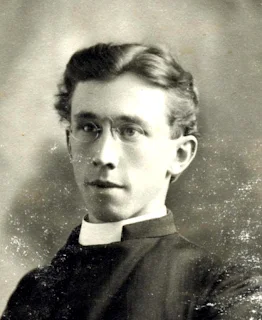
What were they thinking, back in the day, when 20-something, fresh-faced young virginal males were the preferred ministerial livestock? What in that time could they have suffered? What could they have known about counselling, say, the bereft, or the couple locked for years in bitter marital strife? No wonder churches got a reputation for being staffed by irrelevant, dreamy, bookish bird-brains.
Butter could not melt in that mouth

Every time I complain about how old I'm getting, I need to remember that if this work is worth doing, I actually NEED the aches, pains, losses, scars, and open wounds I carry from a half-century of living on this 'b*tch of an earth' (as Beckett put it).  All the dark stuff we enshadow to make ourselves look so capable and invulnerable--the doubt, fear, and despair we keep constantly at bay--is precisely what gives us solidarity and communion with our fellow beings. It is easier to feel closer to someone like Larkin, who puts all this out there, tells his secret terror of death, than to someone like, say, Donald Trump, who has evidently never had a moment's self-doubt (even about that absurd comb-over of his).


Sir, your mortality is showing...

In fact, now that I think of it, Trump's combed-over quiff is an excellent emblem of the armour of persona, the shiny shop-front we construct to meet the world that doesn't want to hear about our fears and failings and mutability. All such constructed selves are usually absurd, swept as they are over phrenologically lumpy underside writhing with demons of mortality and decay. As more hair falls out and the lumps begin to show, more hair spray, more elaborately concupiscent blow-waves are needed to hide the awful truth--and the construct gets stranger and stranger.


Such a natural look-one of the many faces of denial

In an age of Berlusconi's hair-transplants (which he denies), Clooney's nip'n'tuck (which he admits), and washed-up rock-chicks' collagened lips (looking for all the world like a transplant from Nemo), we have never in human history been in greater denial of aging, and the only end of aging.  There is nothing more mutable than the flesh, but you wouldn't know it. We seem to have lost the knack of aging gracefully, in full realisation and acceptance of the life cycle. Perhaps this is because no-one any longer believes in heaven, and the idea of fitting your INNER life for the next world seems pointless.


You can always tell the age from the hands, they say.

If this is IS all there is, it's hard to argue with that ethic. But notwithstanding all the glossy surfaces, "to this end must we come" as Hamlet said, and the dying man I will sit with today is having to weigh all this--fear, faith, doubt, meaning, purpose--and in that grapple, it's good to have someone in your corner, ready with the water and the towel, a witness without words, to "ad-minister" some comfort.

The "ad" part means "to the other". Let me not forget that today.

Solidarity forever.

Post-script: news today that my friend has passed away, Christmas morning. I had visited him two days earlier, and the fore-going was written around that visit.

In accordance with his wishes, I have been asked to conduct the memorial service. Past suffering now, he goes ahead to discover the great mystery. I will do my best for those of us who remain and will miss him.