It's a curious existential moment when you see a beloved old friend after a gap of many years.
There's a kind of time lapse effect that happens in my brain, at least, when the vision of my old friend before me is overlaid on the loved memory-image I've carried around in the intervening years. Your mind, well mine at least, spends some time simultaneously entertaining two hypotheses of what must be there beyond the image in my retina. And during that time, your mind (mine again) does what it does between frames of an animated cartoon--fills in the action. I see them age, in time-lapse, before me. It creates a sharp, tender shock.
Where a person ends and where his friend begins is never entirely clear. Relationship is alchemy.
It is at such moment when you realize that this life is made precious chiefly by those with whom we are privileged to share it. This privilege is only partly earned; it is mostly, I think, a gift.
Yesterday was the occasion of the retirement of one who has been my oldest, continuing, deep friendship in the UK. Those assembled were an old crowd of friends who started working together, when we were a generation younger. We built careers together, created and raised children, travelled together, and shared the myriad tiny triumphs and the inevitable personal failures that make up the rich pattern of any normal life. The pub rang all evening with the rich laughter of remembering. Wine flowed, and we broke bread. And that communion was not the end of the sacramental dimension of the evening.
Every meal shared in joy and generosity is a communion.
Many were with partners different from those we began with, and many who would have been there, had moved on to other climes and lives, as I have done. And so I thought it fitting, when toasting-time was ripe, to lift one "To absent friends."
"Absent friends". How that phrase stuck with me as I rode the train home to Manchester, which is soon to my home no longer, in a few days. Travelling, moving, and self-imposed exiles are often called "the curse of the Celt", and I've got it in spades. There as a lot of love in the room last night, but the truth is I have been a absent friend to these, and to more than these, and last night's reunion brought that home. Absence made a lot of hearts grow fonder, and the occasion and the wine helped too.
An awareness of what is missing
As every psychologist knows, memory has a in-built prestige-enhancing function, a mechanism by which the terrors fade, the joys remain and are morphed into a personal hagiography. We remember our kids talking earlier, the travels more joyous and not at all dull or difficult, and perhaps even the role we played in people's lives more central or essential. But we can remember things in no other way, at least not without professional help and careful reconstruction. What I remember feels real, so that's how I take it.
The memories I've hoarded from our shared past, along with a steamer trunk of hard-copy photographs, are no substitute for being there, and the wide gaps of time since we were dissevered, I from them, serve to remind that NOW is ever the only time we really actually live in. The rest is a story.
Don't misunderstand--last night was a rare joy. But I also got the sense during the prolonged hugs goodbye that more of us than just me wanted to have a good hard sob about where the years had gone, and how now as retirement, and the only possible end of retirement, begins to loom for us all, that we want another crack at doing over and doing BETTER the friendships that had so sustained us during a time in our lives when we were young and had the whole future--that which we now grow old in--ahead of us.
My compass is cracked.
My maps are smudged and old,
And I couldn’t find the right
Survival gear for the wet and cold.
I can’t quite trust the compass:
Its memory of poles locked within.
I mean, it works and all--
But I forget which hemisphere I’m in.
The maps are so old
That Indonesia reads “Batavia”,
And some ‘Soviet Union’ still
Spreads blood-red across Asia.
And I searched every website
To find just the ‘right stuff’,
But it’s made in those places
We warred with.
I thought: “enough”.
But the windcheater doesn’t,
And the cargos split at the seams,
And the shoes, the shoes
Are like wearing little trampolines.
You know I’m lost, but I love you;
I’ll be there as soon as I can.
Though my lens is a cleft world view,
I’ll be there as soon as I can.
Less than two weeks left at theological college. Shipping boxes packed, I'm down to a suitcase and a briefcase and a travel guitar, and a strange, dissociated feeling.
As I prepare to close one chapter and open another, I find myself in that liminal space, the edgelands between actual places, where one is neither here, nor entirely there.
It's difficult to get your bearings in a long twilight, and difficult to gauge direction when you, for a time, belong nowhere in particular.
In transit: a 'world without end', without borders, sans frontieres.
For me, this will end. But God help those for whom such days are all their days: refugees, asylum-seekers, the perpetually displaced. They're everywhere, but hidden away from the sort of people who will read this.
His name was Neil, and he was from Toronto, Canada. Early 40's, I guessed. Great smile, hard not to warm to.
"You're a long way from home," I said.
"So are you, brother. American?"
"Baltimore, originally."
"Lovely city," he said. "Know it well. Great baseball town-- you an Orioles fan?"
And we were away...
Like the weather for Brits, baseball is phatic talk for Americans (North and South). But this wasn't simply two fans shooting the breeze.
Neil tells me he played third base for the Toronto Blue Jays, actually in "the show", the big leagues, a utility infielder behind the seriously great Corrie Koskie, a young prospect and potential hall-of-famer. Neil made it to the show late in life at 29, after years in the minor leagues, brought in specifically as an old-timer to give the youngster the benefit of his experience, if not his talent. He got a little game time, drew the league minimum pay, but travelled to the big parks all over the US.
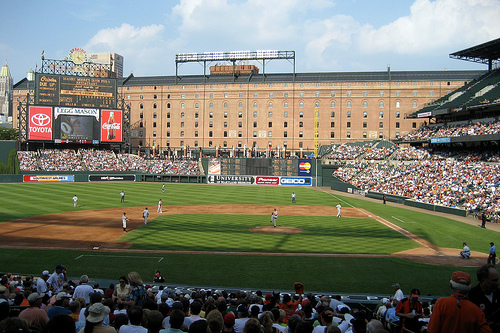
Including Baltimore's beautiful Camden Yards, perhaps the most beautiful ballpark there is. It's home plate marks the spot where Babe Ruth's father's bar stood.
There's no such seat as a bad seat here.
He says he played in my hometown park many times, waxed lyrical about the nearby Inner Harbor, where he and his team-mates wolfed crabcake dinners, washed down with ice-cold beer on the long balmy summer evenings. Loved Baltimore. Loved life in the show.
The thing is, we were having this conversation on a wet Tuesday night in Manchester England, at a bus stop on the Oxford Road. I had just come from seeing an arthouse film nearby, was heading back to my flat.
We boarded the bus together, and I could see by the interior lights that Neil had been living rough: grimy hands, rugged clothes layered for warmth. Computer bag, sans laptop, but papers sticking out of every compartment.
We climbed to the top deck of the bus, and I sat, but Neil stood at the front against the big glass window and launched into his set piece speech for the assembled crowd, mostly of uni students heading back to their lodgings from the city, as well as uncomprehending Asian men, heading to the Curry Mile.
"Ladies and gentlemen, I'm sorry to have to do this. All I can do is tell you the truth, and ask for your help. I haven't always been as you see me now, I'm a father and a grandfather. But I've been having a hard time lately. I need 20 pounds today to get into St. James shelter tonight, where they'll give me a bed and a shower and food. But mostly security, because it's not safe out on the streets. I have 13 pounds, so if you..."
For 20 quid, this would be Neil's safe-at-home
He said all this looking down at his worn shoes mostly, only occasionally looking up as if he was remembering his media training. He worked the aisle, and finally came back to the front, where I was. I gave him 2.20, all the change I had. His take was still a little short of the 20 he needed.
Then he sat next to me and told me point-blank the story that had been hanging in the air for the last several minutes. A story about never quite making it in the show due to his late start (29 is elderly in pro sports if you ain't got runs of the board). Taking to drugs for consolation, which then took to him in a way he didn't expect. A bad and busted marriage that brought him to the UK. Divorce, bankruptcy, kids taken away. Then, the streets...
Neil's neighborhood.
But he was clean now, had been for 9 months, and was trying to put some kind of life back together.
Then he asked me what I was doing in the UK, so far from the Baltimore of his fond memories.
Deep breath: Unitarian ministry, I said.
He took my hand and wished me well, apologizing for the dirt, but that it had been 'a particularly hard day'.
And he said that there could be no more noble life than devoting yourself to the service of God and others. It was my turn to look down at my shoes.
He said that you've gotta have God or the Spirit or something at the centre of your life if you're gonna get yourself straight.
"There's no other way," he said, heading for the exit, flashing a smile that would have, at one time, been 100-watt.
And he swung off the bus and back out into the night, and was gone.
Baseball is often called a game of inches.
In a season of 400 or so at-bats, inches make or break you: to have just ten hit balls break an inch or two shy of being caught...or a pitch that hangs just an inch or so in a hit-able zone above the plate... or a half-step between making it to 1st base before the throw out from shortstop. These inches make up key playing statistics, and are all that separate a failed career from a great one, a life on the rough from the sort of money that will mean you'll never again have to work a day in your life when you leave the game. Money that can buy a lot of rehab.
Well, there goes Easy Street...
Neil didn't get these inch-breaks, and didn't have the inner resources to take it well. And just like that, you're on the mean streets of Manchester trying to stay clean and, at a minimum, get indoors so you don't get rolled for what little cash you have. I'm sure it all seemed like yesterday to him--the big ball parks, the TV cameras, the hotels and airports, and beers with the boys on Baltimore harbor.
I'm glad of course that there are places like the St. James (Anglican) shelter, and quietly mortified that my own denomination offers NOTHING of the sort, and that all I could offer him was pocket change and an ear.
Because not all that long ago, at a very low point, it would have only taken one or two irrational decisions for me to be exactly where Neil is. I was just luckier, with better friends and family, in a country with better health care, maybe armed with a sturdier psychology, having been born to functional, loving parents. All factors beyond my absolute control, in the game of inches called 'life', which remind us of the truth of "there but for the grace of (fill in the blank), go I."
"There's no doubt life's a mystery, but so too is the human heart."
--Mary Chapin Carpenter, John Doe no. 24
So why is there no picture here of Neil in his heyday? After all, you don't need a degree in IT to find pics of pro sports players. Just a Google-search, which I ran when I got home, trying to find him, trying to get a little more insight into this strange, brief encounter on a Mancunian bus.
And it turns out there never was anyone named Neil that ever played for the Jays, not ever, not in any level of the Jays organisation. Not one, not ever.
New identity, name change? I scanned hundreds of player photos. Nope.
Did I get the Jays right? Maybe I misheard...maybe it was the Expos of Montreal. Nada.
Maybe this was the most elaborate shake-down ever by a professional beggar who's mastered the 'short con'.
But as I put this little blog post, and myself to bed, it is hard to shake the feeling that this mystery man, who arrested my attention with his charm and his story--an up-beat, beat-up Canadian Ancient Mariner--this guy I met looking for shelter--is actually me. A version of myself that slipped out of a parallel universe created by different breaks and life choices, a fun-house-mirror view of the man I could easily have been, and at one time just missed becoming...by a matter of inches.
How precarious is this life, dear reader! How much our fortunes are finely tuned and balanced by powers not our own. Only when you know this, really know it, does the empathy and compassion required of us by Jesus, Buddha, and so many others, seem achievable.
"Hobo's lullaby", written by Woody Guthrie (mon hero) and sung by the amazing Emmylou Harris.
So g'night, "Neil"--or whoever you are. May you find peace and rest someday.
Donations can be made to the St James shelter--just click the links above.
Before drinking single malt and waving the flag, before we let triumphalism so flood our neo-cortices that rational thought becomes not merely impossible, but perverse, have a go at answering this simple quiz:
1. Explain in sound-bite length the answer to this: So we can stop the wars now, right? If not, why not?
2. Demonstrate (by logic or magic) that the 5,885 total fatalities borne by coalition troops in said wars in any way, directly or indirectly, brought about the death of OBL. Then explain your proof to one of thousands who's lost his legs or eyes in said wars.
3. Compute the efficacy of our violent actions in Pakistan, given this ratio: 2000 killed (most collaterally) by predator drones to 1 by bullet. Then factor in cost-to-taxpayer of said drones.
4. Argue that justice has been served by execution rather than capture, interrogation and trial. Be sure to define your use of the term 'justice'.
5. Compile and present what proof you have ever personally seen (rather than been told) that OBL is guilty of instigating the 9-11 attacks. Extra points for photos/videos. Critically analyse the interest positions of the sources of the evidence.
6. Perform a cost/benefit analysis on the funding and training US gave OBL to resist the Soviet occupation of Afghanistan in the 1980's, in terms of the skills OBL has used to elude execution/capture for the past ten years.
7. True or false: The Taliban have never been more effective than they are now and they appear to be much, much larger than al-Qaida (hint--source: American Intelligence, BBC News).
8. Calculate, in units of millions of votes, how this will affect President Obama's re-election chances.
9. Estimate the impact of winding up two large-scale military operations upon the looming US budget deficit.
10. Explain to a clever 12-year-old how creating a martyr out of someone (who has long since ceased to be anything other than a figurehead) is anything but a propaganda win and recruitment boost for Islamic militancy as promulgated by the Taliban, Al-Qaeda, etc.
Pass your completed sheet to the MC. Do not offer him violence. He is only the messenger.
There seem to be two basic views about the Royal Wedding (now why did I capitalize that?).
1. Relax and enjoy the fairy tale (royalty, Englishness, empire, national unity, the promise of social mobility for commoners like Kate)! Times have been tough--let's party!
2. How can we afford this when we can't afford education, health care, job training, public transport, etc., etc.? Roll on the Republic!
The first counsels brief happiness at the expense of engagement with truth of things as they are; the second counsels righteous anger at the expense of a good knees up which everyone clearly seems to need.
Princess Beatrice obligingly came dressed as a Yak. Or a Georgian architectural folly--I'm not entirely sure.
I see both points, I really do, though I have always been a staunch republican (not the GOP, you understand). I also like a bit of fantastical escapism, me.
But I'm getting old, and the echoes of Cassandra-like warnings from the recent past about the present we now live in were brought back to me by the whole affair.
I used to teach English Lit. and an interesting task was always to get students to compare the twin pillars of 20th century dystopian novels--Orwell's 1984, and Huxley's Brave New World. Both were written mid-last-century. Both predict a politico-social order to come (about now, actually). Both predict a dystopia in which individuals will lose what is taken to be their humanity--their emotions, uniqueness, will, inner life.
BUT--in Orwell's book, social control is achieved by force and coercion--what the Frankfurt school philosophers call RSA's (Repressive State Apparatuses). A security state using violence, torture, informants. To a degree, and in some places more than others, this has come true. Ask a Syrian.
Thankfully, this didn't come to pass for us. Or did it?
However I think it is Huxley's opus that gets it right for the Anglosphere--Britain, America, Australia, etc. In this book, control is achieved by narcotics, elaborate diversions, sensuality (or its promise), in short by escape from a reality in which the individual person is effectively powerless to do anything other than indulge and distract him/herself. Plus the ideologies at work in the public sphere that make these practices seem normal, natural, and right.
This one did come true.
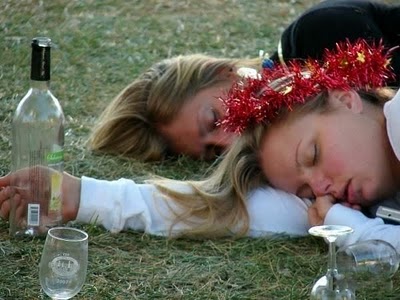
A bottle of cheap Prosecco, a fantasy on a flat screen (on credit), a public holiday, and cake--is all we need to carry on for a while longer in a country that is over-crowded, bankrupt, and paradoxically increasingly squalid and hideously expensive for the overwhelming majority of its 'subjects' (I use the word advisedly).
'Soma' was the name Huxley gave to the cheap, easily acquired narcotic that kept the helpless souls of his dystopian idyll happy and complaint.
"There's always soma to calm your anger, to reconcile you to your enemies, to make you patient and long-suffering. In the past you could only accomplish these things by making a great effort and after years of hard moral training. Now, you swallow two or three half-gramme tablets, and there you are. Anybody can be virtuous now. You can carry at least half your morality about in a bottle. Christianity without tears-that's what soma is."
- Aldous Huxley, Brave New World, Ch. 17
Soma...somnolent...somnolence....all drawn from the same root word meaning sleep......zzzzzzzzzz.
"Whassat Kate Middleton goth that I aint got...?"
Go back to bed, Britain. Your nation is great and splendorous again.
Go back to sleep, Britain. We are one happy nation in the sun, building the new Jerusalem, a shining model for the world.
Go back to sleep, Britain and let nothing wake you from pleasant Blytonesque dreams of picnics and lashings of cream.
Meanwhile, libraries shut. Home care services are cut. NHS officials are finding ways not to treat people to keep costs down. And a railway ticket between major cities costs a week's wage.
First slum of Europe: a role It won't be hard to win, With a cast of crooks and tarts*. (*Author's note: take a good look at the guest list)
And that will be England gone, The shadows, the meadows, the lanes,
The guildhalls, the carved choirs. There'll be books; it will linger on In galleries; but all that remains For us will be concrete and tyres.
--Philip Larkin: "Going, going"
So why not open the Prosecco, look adoringly on the Lords and Ladies, and dream again of the past? I can think of no reason why not.
"They that can give up essential liberty to obtain a little temporary safety
deserve neither liberty nor safety." --Benjamin Franklin
Call me old-fashioned, but I think an essential liberty worth defending is the liberty not to have our under-aged children extensively groped by some anonymous hired goon in a uniform.
A reasonable assertion, surely, yet this is a freedom we apparently no longer have. Witness:
If you were the parent, the grinding indignity of watching this forced upon you, what would YOU do?
It took me about a nano-second to realize that, had my very beautiful 14-year-old daughter been in this little girl's shoes, I would now be sitting in jail on multiple security and assault-related charges. Why? 'Cause I'd have broken their arms. Which is why THESE parents are way smarter than I: they filmed it in all it's stark, damning Auschwitz-ness.
I do not think I overstate. The guard is an ordinary person "just following orders/procedures", very professionally. Anyone with an ounce of sense knows that the child poses no actual threat to the Reich. The helplessness of the parents having to witness their innocent offspring being man-handled by the state is a key part of the control mechanism: "If we can do this to kids (and we can, see?), imagine what we can do to YOU if we feel like it." A non-consensual violation of a child's body--something that would meet with the harshest penalties and the sternest social disapproval in ANY other circumstances--is allowed to pass as normal, necessary and right, as banal as ticking a box. It's that banality, the casualness of the cruelty, that is for me the most crazy-making aspect of this. "It's all in the interest of the greater good, so what are the parents so upset about?
"When they came for the 6-year olds, I said nothing because I was not a 6-year-old."
Nothing new to see here, citizens. Move along.
And let's be clear: transport security is largely theatre, creating the feeling of improved security without the reality. Oft-quoted stats from the absolute height of security paranoia in the six months immediately following 9/11 indicate that the following passed through un-detected:
70% of knives
30% of guns
60% of fake bombs
But they never fail to notice your damned water-bottle. Nice work, team. Bet you sleep like babies at night.
And do remember that the 9/11 hijackers initiated all this mayhem with box-cutters.
Conclusion: That's right, your kids being clumsily groped buys not one iota of safety. So the humiliation, loss of liberty, and probable psychic damage of a child were for nothing.
My old pal, writer and wit Dave Belz says:
"I've got a clean driving record, no criminal convictions, a stable job and a permanent residence in the U.S. I should be able to have a sticker on my driver's license or passport that says: "OK to Fly." Talk about where we could cut spending..."
Anyone capable of irony is probably NOT the dude you're looking for.
Similarly, 6 year old American kids are so unlikely to be hiding bombs in their pants (watch the video if you haven't already and if you can stand it), that the CERTAIN damage to people, to simple justice, to human rights, and to common sense certainly outweighs the POTENTIAL threat.
What strikes me as particularly absurd about all this, is that the defenders of post-Patriot Act security are usually the same people cozily assured of heaven and their place in it. Those who croon sentimentally about death--"Don't worry, honey, Nana's gone to a better place."
Strange, is it not? If the after-life really is better than this veil of tears, if there's pie in the sky when we die, if it's all in God's hands anyway, why the paranoia over being killed by some vicious evil-doer? At least it'll be quick. But no one who ever thought carefully about their theology embraced an injustice in the name of something so provisional.
Quick is, I fear, NOT what will be this child's recovery time. Nor will be quickly relieved the parents' sense of impotence at the bizarre injustice of a 'freedom-loving' country.
By such small increments does hard-won, man-made freedom die.
I have an uneasy feeling that France's burqa/niqab ban won't end well.
From today, it is illegal to wear one in public. To leave your home while wearing one is an intention, therefore, to commit a crime. Police will not have the power to remove it, nor will they insist that it be removed by the wearer. They will simply ask the wearer to accompany them to the station. Creepy, I say.
For those who don't know the variations on the theme.
The rationale for this has nothing to do with race or religion, we are told. It is simply a matter of security--people should not be allowed to hide their faces in public. Likewise, it will be illegal to wear a balaklava in pulbic, which will be a blow to skiers on the pistes of the Valle d'Ser (sp?).
Implications for street mimes, people on their way to fancy dress parties, commedia dell'arte troupes, Zorro and Batman impersonators, and the like, are still being worked out.
Clearly a security risk
In short, everyone wearing anything which masks their normal visage will be assumed to be going about incognito--lying about who they are, in effect. I mean, what good will the profusion of security cameras do if your physiognomy can't be captured and scanned and archived? How will the surveillance society we have become over the past 15 years or so function properly?
(Which begs the question: when did my right to ponce about like the Lone Ranger get eclipsed by national security imperatives? Not that I do...)
The Preach-for-Food solution: better latex-based masks. Any actor knows about the wonderful efficacy of foam latex to produce life-like flesh and facial features totally unlike our own, Mission Impossible style. If the problem is that the burqa/niqab prevents a view of a woman's face and hair, a view which would otherwise drive men wild with unrestrainable lust, simply ugly up, thus:
If, on the other, hand the mask on the right also drives you wild with lust, you may need to seek professional help.
But I jest and I digress.... A story from life, 'cause you couldn't make it up:
As many of you know, I live in a predominantly Islamic part of Manchester, the "Curry Mile" as it's called. The other day I was standing in a queue with a small group of Muslim women, dressed in full, black burqas. My sense was that they were related, as there was a small squad of kids running around between them, playing, seeming to know each other well. One very little muslim girl, shy at first, was clinging to her mother in all this mayhem, and gradually joined in the running around.
The Curry Mile: The Lahore of the North.
The queue advanced and the positions of these identically-clad women shifted. When the little girl had had enough larking about, she went back to look for her mother--and I watched as she stood there genuinely confused for a moment about who to run back to. She ran up to one woman and hugged her legs, and was gently corrected that, no, she was not her mother The woman who was her mother spoke up, and the girl ran back to her hug her legs, relieved.
A Muslim man and I had watched this exchange, and he smiled at me as if to say--"happens all the time in our world".
And in that moment I kind of got how stupid and reactionary the burqa ban is--what the hell do I know about the complex and subtle daily negotiations around the burqa such folks go through every day? How do I know, for example, the sexual politics around it--that the woman under the burqa is actually being coerced into wearing it. How do I know that it is not a conscious choice which has costs and inconveniences she's prepared to deal with?
Come to that, living on the curry mile, I've felt a lot more threatened by the EDL thugs that roam the Muslim quarter looking for trouble, than by any of the demure, polite, courteous muslim men and women I meet every day.
Security risk? Anyone can hide anything anywhere, if they want too bad enough. I mean, people sneak knives into jails, and in jail they look in your a**. As a security measure, the burqa ban, therefore, is a blunt instrument, and cannot in itself prevent a single terrorist act.
What it WILL do is further polarise an already intolerant social order, quietly demonise muslims, and perhaps prop up the fortunes of an unpopular President de la Republique, by taking support away from the far right Le Pen goons. It is populist fear-mongering travelling incognito.
How many Muslims do you think he included in his focus-group discussions?
While it targets the deeply held beliefs of a particular culture, last thing this is about is religion.