Popular Posts

Monday, July 29, 2019

How do you think this ally went?

Recently, I received an out-of-the-blue email from a Year 12 student. I might have legitimately said: "Get lost, I'm busy". But it seemed strangely urgent to answer their questions...er, straight.

Dear Minister of the SA Unitarians,

I am a year 12 student at Nazareth Catholic College, and I am currently undertaking my Religious Studies external task, in which I have decided to focus on the acceptance of transgenderism in the church. I believe your church would be a great source for me and was wondering if you would be able to answer a few questions in this area of focus to help with my research.


Below I have attached some questions in hopes to gather some feedback for my studies, by which I am hoping I can reference in my research.


  1. Could you outline for me, your church teaching on transgender individuals?
  2. Do you believe one’s gender, in particular, transgenderism, affects a person’s relationship with God?
  3. From your experience, how accepted have transgender individuals been in their religious community?
  4. What does the Bible allude to in terms of instructing transgender individuals, and how does this reflect on the dignity of the human person?


I hope to hear back from you soon. Thank you for your time.


Kind regards
XXXX


Obviously, I was going to need to 'speak their language' somewhat. So here's what I said:

Hi XXX,

Thanks for getting in touch. You've chosen a very interesting and important topic contemporary religions need to deal with. I'll try to deal with these succinctly here, but am open to further questions/discussion on them. Don't hesitate to get back in touch if anything needs clarifying or more info. Well done, you. And good luck!

Could you outline for me, your church teaching on transgender individuals? 
First, that transgender individuals, like all God's children, are evidence of the diversity of his creation and are individuals with inherent worth and dignity, just as anyone else is. Second, that transgender people are systemically socially and politically marginalised, demonised, and misunderstood, so we are called as people of faith to welcome, affirm, and support them. This is entirely consistent with the ministry of Jesus and the Christian tradition.

Do you believe one’s gender, in particular, transgenderism, affects a person’s relationship with God?
In the transcendent reality of God's eternal and unbounded love, gender is irrelevant. From a transgender person's point of view, they may FEEL as though they are less worthy (or sinful or whatever), and it is that socially-learned misperception that church community exists to challenge, confront, and dissolve.

From your experience, how accepted have transgender individuals been in their religious community? 
They are fully accepted in ours, and ours is the only community I can speak with any first-hand authority about. We have had two transgender individuals 'come out' in our worship services in the past couple years, and they have found a warm and welcoming home here.

What does the Bible allude to in terms of instructing transgender individuals, and how does this reflect on the dignity of the human person?
I'm not sure I understand this question, as I'm not sure the Bible addresses the issue explicitly. In general, we do not see the Bible as divine dictation, and therefore not the one single, infallible source of every answer for every question. We believe those who think of it as such are confusing the wine with the wine bottle. This may be hard for Christians to hear, but Unitarians are in fact a post-Christian faith tradition, interested in getting to the essence of faith beneath the dogma of text and tradition, and we use many sources of wisdom to do so.

Yours in faith and service,

Even as a hetero-normative cis white male, I like to think of myself as a good ally to the LGBTQi+ community, but seldom feel sufficiently 'woke' to address why in terms of religious faith. I wonder if any of you could suggest how I might have answered these questions better from our UU principles?


Monday, July 8, 2019

It's about time everybody watched this one again.

Fighting a full-on dose of Influenza, I managed to croak out the last ANZUUA worship service in October 2017. As the Ministry of our church enters a period of transition, it is time to revisit its main points again.

You can't see the screen in the video, but these are the questions referred to at a certain point:
1.Will small and struggling church be the new default?
2.What would churches that buck the trend look like?
3.Can online engagement replace/supplement physical co-presence?
4.To what degree will online engagement encourage consumerism, ‘iChurch’ of personal preferences? What of community-building?
5.What happens to U-vangelism, discipleship, pastoral care, RE, and  mission with decreasing attendance/affiliation?
6.What is the future of professional ministry and leadership?

(Readings by the excellent Barbara Willow.)


Monday, April 8, 2019

Gratitude Adjustment

I wrote this eight years ago while I was studying for Ministry, and never finished or published it. So what the hell...I've finished it, and am publishing it now:

For years I've dreamed that one day I could get myself into a position to do nothing but read, reflect, and write. That one day I'd manage to slough off, just for a year or two, the endless rounds of work and getting and spending and the thousands of distractions that conspire to yank you out of purposefully exploring an inner life. I thought if I could manage that somehow, all the stuff I've done and all the roles I've played (on stages and off) over the years would somehow coalesce and resolve into something like an integrated self. And once coalesced, like the colours of the rainbow, it might become a white light to see more clearly with.

You are both you, and not you.

And somehow I have actually carved out a little island of time, a year or two at best, before returning to a working life again. Those close to me know that getting here has not been easy. I chucked my good job like a bad suit of clothes, cannonballed into the lake of under-employment, and dog-paddled for 18 months doing part-time teaching, voice-overs, some preaching and some acting. Then I got on a plane, and here I am, half a planet away from my much-beloved wife and daughters and my good Australian friends.


I'm free, b*tchez!!!!

So how's that working out?

Being alone and with only just enough money to subsist on has been a tough adjustment, I'll admit. But the abundance we become used to in the western, middle-class life comes at a cost, impoverishes parts of ourselves that not even Heineken can reach. So there's this big empty psychic space where work, people, chores and media once occupied, as well as the role-playing these required.

Though there is much in the way of assignments, reading, and service-writing that I'm called to do as part of my training, to my utter surprise, what has flooded into that newly emptied psychic reservoir is gratitude. 

No joke. 

I feel  heart-achingly thankful for everything and everyone I've ever known in my one, finite, inconsequential, little human life, and this feeling comes with an intensity that is sometimes hard to know what to do with.

It's not that the experience is a slide-show type list of people and places and events and things. It's more like how parched land receives the torrents of spring; all at once it comes, and the earth softens and yields and gulps it in.


You don't miss yo water, til yo well runs dry...
In this flood, so much rushes past, I wouldn't know where to begin making a list, for fear I'd overlook someone or something, or that a list might seem to imply a prioritizing. Nor do I want to gush or wallow in these good vibes here, but to reflect on how much of the way we mostly live impoverishes our spirit, and makes us less than fully human.

Vacations, holidays, sabbaticals are meant to function as psychic pressure valves, to release the inner tensions created by the differentials between our 'full-spectrum' humanity and the narrow channels which the workaday life conspires to pound them through. I met a ministry student here, who, after 20-odd years of working as an accounts officer for a large firm, felt that somehow this was not entirely fulfilling.

Ya think?

Over those years, her involvement witth her church community kept alive the dim but persistent vision of horizons far grander than the next promotion, or monthly productivity targets, or what she could buy with the money she'd earned. It seems that much of the lure of 'retail therapy' is the acceptable, consumerist version of  getting hammered at the weekends or popping Zoloft to get through the cramped prison of your days. Keeps the economy chugging along too, so there are endless incentives for burning up the charge card, and thereby making enslavement to drudgery more necessary.

I remember daydreaming in grade school on a sunny spring day, thinking how much I wished I was outside in the open air, wandering through trees alive with bird-song. One day, I thought, I'll be grown up and be able to do just that. But I found, as most do, that the journey we call 'life' is a process of swapping one crib for another. From the school desk, to the office carel, to the gated retirement community, to the grave. And all we work to accomplish is merely to determine how well-appointed each crib will be.

Some folks thrive on the treadmill, though, and good for them. Some thrive on the treadmill while dreaming of not being on it. Not so good for them, perhaps. Some renegades, like Joyce's Stephen Daedalus, thrive on silence, cunning, and exile from all that. 

Which of these am I now that I am a Minister? I have no less a sense of work as a grind. I too grind on, daydreaming of golden days ahead that I probably won't know what to do with myself in. I love too many people and things in this prison too much to want to run away from it. 

So I conclude that I am, yes, grateful for the grind. It connects me to people. It keeps my days in order. It bears me up when I flag. The grind is the grit this little oyster is grateful for. Not so much for the pearls themselves, as for the broad parameters which make me as free as one in this world can be, rather than lost in it.

So thank you, God.

Monday, March 25, 2019

When you're asked to co-host a prayer vigil, so long as you don't offer a prayer

As a response to the Christchurch mosque shooting, our church was approached by the Catholic Archdiocese to co-host an Interfaith Service of Prayer at the city Cathedral.

Under the circumstances, this is not something you say no to, regardless of public media stoushes you may have had with the Archbishop, who would be leading this service. Time to put away such differences in the spirit of interfaith harmony, meeting on values everyone from Wiccans to wild-eyed dervishes can agree on: murder is bad, religious bigotry is bad, our faith divisions are deeply to be regretted and overcome.

Just because something keeps happening, doesn't mean you get to stop regretting it.


The advert, as you see, has every religious symbol imaginable on it, including the UUA flaming chalice. One spiritual tree: many fruits. Religious pluralism in a nutshell. So, as I say, we agreed to co-host (without quite knowing what that meant) and I wrote this prayer to offer along with all the other faith traditions:


Interfaith Peace Vigil Prayer

St. Francis Xavier Cathedral

24/3/19

(based on a prayer by Sister Joan Chitister)

As we come together today, reaching across our many faith traditions, in human kinship, let us pray:

Great spirit of life, known by 99 names and many more names, yet beyond all naming, known in many ways, yet beyond our knowing:

may our prayers today call your eternal and limitless presence more fully into our awareness, that you may search our souls and lift from them any vengeful reflexes, any lingering lizard-like urge to hurt by word or by deed as we have been hurt by deeds and by words, to punish as we have been punished, to terrorize as we have been terrorized,
in that presence and awareness, may we find in ourselves the strength to listen rather than to judge, the strength to trust rather than to fear, the strength to try again and again to make peace in a world we co-create through you, in you and with you, moment by moment,  thought by thought, choice by choice.

Great author of all things, you know our hearts deepest desires, our highest thoughts, our noblest aspirations: we seek for the grace to be our best selves, we seek for the vision to build up and fortify our human kinship, rather than degrade and destroy that kinship; we seek for the humility to understand the fears and hopes of all our brothers and sisters, even those led to desperate acts of madness and destruction.

We seek to bequeath to the children of the world to come more than our failures; we seek for the godliness in us that it takes to care for all people… as well as for ourselves.

To these high aspirations and deep longings, may we constrain our might,  may resist the temptations of power and refuse to attack the most readily attackable, may we understand that vengeance begets violence, that we may be bringers of peace wherever we go, that may we become more merciful and more patient and more gracious and more trusting, knowing that no one yet has found the limits of your love and mercy. The love and mercy which holds us now.

So may it be. And may we cause it to be so. Shanti, Shalom, Salaam, Namaste, and Amen.
So imagine my chagrin when I showed up, was ushered to the "reserved" section along with the local New Zealand charge d'affairs and the Governor General, opened the program, and discovered that The Unitarian Church of South Australia, co-host of the event, an Adelaide church since 1854 and formerly directly across from the Cathedral, was NOT listed among the faith traditions that were offering prayers that day.

And also, strangely, neither was the Uniting Church of Australia represented in prayer. And they're HUGE.

So much for interfaith harmony.

So I sat there and prayed with everyone else, seething quietly. So much for peace in my heart toward my brothers and sisters in clergy. I was angry and felt disrespected. In the pew, I debated with myself about whether I should seek an explanation (and whether I would buy any one that was likely to be offered). And blaming myself for having cocked a snook at the Archbishop in the media several months ago. This is how power works: it never forgets. It gets even.

But what got me out of this dark, crazy-making state of mind was the collective affect of the service itself. It was truly an example of the spirit making you see the bigger picture, getting you to release your ego, lifting up your eyes and heart and remembering what's important.

Don't let other's pettiness make you petty, it seemed to say. Don't seek for vengeance. Let go, be bigger than this.

And so it came to pass that once again, something Bigger than Me reached down into the grave I had dug for myself, and lifted me up and set me back on my feet.

I should know this by now. But once in a while, you need reminding: it's not about you. The hospitality of co-hosting has to be freely given and not a means of vaunting yourself or your posse. He who seeks for recognition has no genuine community feeling, Adler said. And by the end of that service, community feeling was all I felt.

Or Interfaith harmony, you could call it. Praise be.

Monday, February 25, 2019

The Non-denominational Chaplain: What's the Point?

Long story short: I was headhunted by a local, private, reputable, boarding and day school to become their chaplain. After much deliberation I accepted, n a part-time basis so that I could MAYBE still look after my church and the nearly 2000 new souls that suddenly appeared in my shepherd's paddock.

The outreach potential for UUism is enormous, of course--quite unprecedented in our church's long history here, in fact. So I though it would be, yes, kind of my duty to say yes and try to make it work. It's early days yet, but I'm learning a lot and there is great potential for my ministry and beyond if I want to stay on. We'll see.

This is an avowedly non-denominational school, though its roots spring from the Christian non-conformist tradition. The school body is widely multicultural, therefore multifaith (and none of course--the majority). How to conduct chapel services in this setting?

Here's what I think they can't be:
  1. another teaching moment that talks about religion academically, like a school TED talk (but offers them no actual spiritual experience)
  2. a proselytization tool specifically for the UU movement
  3. a propaganda tool for the school itself
  4. aimless Socratic questioning ("What do you think?", as if I have nothing to impart to the young)
  5. morally relativistic, especially on urgent questions of social justice
  6. coerced--if the Unitarian tradition is about anything, it's about freedom of pulpit and pew (but how's that supposed to work as it's meant to if they're compelled to be here?)
So here's my first go at the first Senior School Chapel service, transcribed verbatim, including visuals I'll be using, to be given today:


Senior School Chapel 1

26/2/19

Music and entrance

Acknowledgement of country


(If you’re having trouble recognising that, it’s the Kaurna acknowledgement of country in Kaurna, probably mispronounced AND in a American accent. Those words translate to this: “We acknowledge the Kaurna people. They are the landowners from a long time ago. We recognize the Kaurna people are still alive. The territory of the Kaurna Plains is exclusively Kaurna land.”)

Welcome: Good morning and welcome to this chapel service. This is called a service because it means to serve you by honouring things that matter. I am the Rev Rob MacPherson, the new chaplain of this school, and Minister of the UCSA just down the road on Osmond Terrace, Norwood. To begin services like this one, it is my church’s rather quirky but long-standing custom to kindle a flame in a chalice and say a few words to set our intentions. Please find a space of stillness within yourself, so you can hear these words in your deeper understanding.

Chalice lighting:

Flames like this both consume things, and cast light.

Like this flame, may these chapel services we share both clear away our clutter and light our path ahead.
May this flame consume any regrets about our past,
any fears about our future year ahead, and any tensions in us today.

May it light for us a path of kind actions, peaceful souls, and joyful hearts.

 “What’s the point?”

We only have 5 chapel services together this year, and only about 20 minutes in each service and they’re often months apart, so what do we make of them? AND since this is a non-denominational school, I’m not going to spend the time shilling for Jesus, Buddha, Allah, Brahman, Zoraster, Lord Chthulu, Zeus, Odin, or the Wiccan mother goddess in these services. But I wouldn’t anyway, because the church tradition I am ordained by is predicated on individual spiritual and religious freedom, and this freedom is something you all have already anyway, even if you don’t think you have it, or even want it. So what would be the point of these services if I’d only be pushing the freedom you already have? At least here in DY, I’m not offering this service in front of a humungous looming cross, eh? 

Ooops, I guess I am now…How’s that feel? Better? Or worse? I’ve always found it odd that Cxtianity chose the cross as its sort of brand logo, and not say, the fish (ICHTHYS—vamp?)

I mean the cross was originally a crude Roman torture machine on which the prophet of the Cx religion suffered a prolonged and gruesome public execution. In its function, a cross is as grisly an object as a gallows or an electric chair. So maybe not a great brand management. Also, Cx are assuming JC would be cool with it. If Jesus ever DOES come a second time, as some believe, do you think he ever wants to SEE another cross? Holding it up to honour him is like…honouring MLK’s birthday by handing out sniper rifle pendants and lapel pins. “We remember Dr. King, we love him (SFX)…” (

Any way the cross is Cxtianity’s business not mine. And you’ve probably heard that bit before too, cause I more or less stole it from another dead prophet--the late Bill Hicks).

So we have a total of 100 minutes (*checks watch* ooops, less now) spread out over months during which a lot happens in your life, which is why I put the question to you in the bulletin: what can be the point of this?  And I’m quite serious. Linguists will tell you you need a minimum of 12 minutes of connected thoughts to get anyone to even consider an idea they haven’t already had, AND then you need to repeat and reinforce in a timely way. So failing a regular, continuous, and connected set of chapels, all anyone can really do is reinforce common-sense clichés: these are the best years of your life, believe in yourself, do what you love and the money will follow, strive for the best that’s in you, fall down 7 times get up 8, and so on. And I can certainly do that, but frankly…I’m too old to waste what time I have left telling you stuff you already think, much less jam your time up too. And when did cliché and banality become worthy activities for bright young minds? And if you think you’re done growing your bright young minds  now, or will be done when you graduate, it’s my sad duty to remind you that your mind will be under construction for some time yet. The rational part of your brains aren’t fully developed and won’t be until age 25 or so.

 The connections between the emotional part of your brain (the amygdala, which governs how you process stuff at this stage of your life) and the rational, decision-making part (the pre-frontal cortex) are still developing—and not necessarily at the same rate. To help you develop that growing mind so you make good judgements, which take account of both thoughts AND feelings, instead of accepting cliché and banality, you should question everything, including the point of chaplaincy and chapel services and the education you’re getting here, including your own “set-in-stone” ideas, and the goals for your own life you’re already setting your sights on beyond this place. 

Question everything! Why Rob?…SEE: good question…. Because you damn well owe developing good judgement to your one and only life, to the social fabric that makes possible the privilege to even ask such questions, and to the future society you’re gonna help build, even if you’re just dragged along while others build it. And you know as well as I do, there are profound changes that have to be made what society already thinks of as common-sense, normal, natural and right. We have to question the status quo, especially our own part in it, or the near future holds serious, possibly mortal, trouble. For example: private education itself. No one seriously disputes there’s rising inequality in our country and the world. According to the OECD, contemporary Australia has been far and away the biggest spender of any advanced economy in the world, of public money on private schools like this one, and that was before a spectacular re-up of an additional 4.6 billion public dollars last year to support private schools. Public schools, on the other hand, teach 70% of the nation’s students. 52% of PS enrolments are from families below the average Index of Community Socio-Educational Advantage. Only 11 per cent of Catholic school and 5 per cent of independent school enrolments come from such low-index backgrounds. As a result, a full 87% of the public schools that educate most of the most disadvantaged students are being funded below the minimum school resource standard with no change planned. You might well question, in a democracy, and in a culture supposedly founded on the ‘fair go’, what could possibly be the justification for spending another $4.6 billion on students who are overwhelmingly from better-off families in already well-resourced schools?

It’s certainly questionable whether or not strong, well-resourced public education, open to every child regardless of the crapshoot of birth, is or is not of vital importance to an advanced economy and to any democracy worthy of the name. Across the world and through history, equality of opportunity has been the difference between free societies and their many opposites. You could question how free can anyone possibly be when the random circumstances of their birth determine the opportunities they’ll get? 


Another question you might ask: what has this to do with you? Well, it’s not beyond question that you may be obligated to ask such a question, because you would appear to benefit directly from an unequal system, and if you know history, you’d know high levels of inequality only ever means: rising crime, broken families, ill health, mass ignorance, and social and economic unrest. No amount of advantage can shield you from the effects of degrading the social order that created that very advantage. We are all bound up together: this is as true for social inequality as it is true for climate change: you can run, but you can’t hide. So what we need for you and from you IS hard questioning, not a repetition of banality and cliché. “The world we have made as a result of the level of thinking we have done thus far, creates problems that we cannot solve at the level of thinking at which we created them,” Einstein said. That’s become a cliché too, but begins to bite a bit when your questioning includes yourself and your own interests. To illustrate a different level of thinking… here’s a true story: 

There’s this farmer who grows the best quality corn in the country.  One year a investigative journo questioned why. Turns out, the farmer shares his best seed corn with his neighbours. “Why would share your best corn seed with your neighbours, when they are entering corn in competition with yours each year?” “Nature doesn’t respect boundaries. The wind blows where it will and picks up pollen and swirls it from field to field.  If my neighbours grow poor corn, their corn will steadily degrade the quality of my corn.  If I am to grow good corn, I must help all my neighbours grow good corn.” As it is below on the natural earth, so it is with we who are a part of nature. For the welfare of each of us is bound up with the welfare of all of us. So yes, question yourself and your interests and whether the advantages you’ve been given are yours at all to hoard like corn in a famine. 
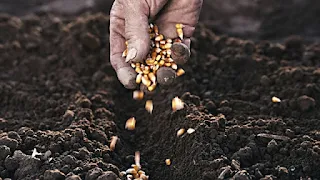
If you do face such hard questions, you will be able think anew and act anew, and the world you will grow can be made anew. Oh and  by the way…if Jesus were ever to come back again, you can bet he would tell you the same thing. 


Here is a prayer that’s been taken from the Cx tradition, but revised for inclusive settings. Please say it with me:

May I become an instrument of peace;
where there is hatred, let me sow love;
where there is injury, pardon;
where there is doubt, faith;
where there is despair, hope;
where there is darkness, light;
and where there is sadness, joy.

May I seek not so much to be consoled as to console;
to be understood, as to understand;
to be loved, as to love;
for it is in giving that we receive,
it is in pardoning that we are pardoned,
and it is in dying to self that we are renewed.

Musical interlude

Benediction and chalice extinguishing

The Chalice flame is now extinguished, but may the fire of our time together live on in the minds and hearts of each one of you. Carry that flame within you as you leave this place and share your light and warmth with those you know, but more importantly, with those you have yet to meet. Amen and see you next month. Exit to music


Monday, November 19, 2018

The King of Nothing

It's official: I've resigned as President of ANZUUA, which makes me a little sad, since it's the only time anyone's trusted me to be the president of anything in real life. I was rather enjoying that. I sent this letter to all churches and fellowships last night:

19 November, 2018

To all ANZUUA member churches and fellowships,

The ANZUUA Committee meeting held today will be my last as President, after a little over a year in the role. There are two compelling reasons for my resignation, which will take place with immediate effect after this meeting.

First, I have taken on additional work next year as the Chaplain of Pembroke School, close to the Norwood Church. This will be in addition to continuing as Minister of our large, growing, and active congregation until the end of my contracted term in March 2023. This new association between these two Adelaide institutions represents the largest outreach potential in the church’s history and requires appropriate time and energy. To meet the demands of both roles, I am streamlining my work, jettisoning non-contractual activities, which sadly would include any continuing work with ANZUUA.

Second, at the AGM yesterday, the UCSA congregation voted overwhelmingly to withdraw from ANZUUA. This would, of course, put me in a false position, were I to continue as President. The ANZUUA Secretary will be receiving a letter from the UCSA Committee of Management in due course, confirming this decision and its rationale, and outlining how the UCSA plans to continue to support the growth of the U/U movement in Australia, as well as the small and emerging fellowships here that have been seeking our practical assistance.

I realize that...we have another UCSA member on the ANZUUA committee. Whether or not she continues to be involved with ANZUUA is for her to decide, but it should be noted that she would no longer do so on behalf the UCSA.

I hope I have been clear about the reasons for my resignation as President, a challenging role I never sought, but have been honoured to have held, however briefly. I sincerely wish you every success in your future endeavours.

Yours in faith and service,


(Rev.) Robert F. MacPherson
Minister
Unitarian Church of South Australia

What the church plans to do from here to not become isolated is for the church itself to decide. I see three possible directions of varying scope:

  • align more closely with the ICUU as an international hub, engaging with similarly large but isolated churches geographically outside the scope of the UUA and GA.
  • form a new Australia-based association which can be relatively easily incorporated and audited, and would enable us to concentrate on small and emerging groups within our scope
  • go it alone; be an independent church in and for the Adelaide metro region, and developed strategic partnerships with like-minded groups here.
What's clear is that the movement in the region is dying, apart from a few groups, and ANZUUA as it's currently formed seems either unable or unwilling to do much about that. Therefore, a new and effective way forward must be found, and the UCSA has boldly committed to finding that new way, whatever it will be. To do nothing and to go on as we are seems worse than futile, it seems irresponsible.

As someone said in The Godfather in relation to an impending execution--"it's not personal, it's just business." 

Same goes here: neither the church nor I bear any malice toward any ANZUUA member or group. But if we are to be in the business of getting the UU message out to the region, we have been failing for some time now. Time to cut losses and make new plans to promote the movement that called us all, from various faith backgrounds and none, together in the first place.

Watch this space to see how we go.

Tuesday, October 23, 2018

What I was supposed to say. What I said. What I should have said.

This year's Parliamentary Interfaith Breakfast was again sponsored by the Australian Catholic University, but was held in Sydney this year rather than Canberra. The plan, as I take it, is to take the event around each capital city in turn, wherever the ACU has a campus and thus the support staff to organise it.

NSW Premier Berekjilian at this year's event

Each year, faith leaders are invited to write a prayer from their tradition, and these are printed in the event program. Of these, a few are selected to be read at the end of the event as a kind of pluralist benediction. The meat of the event itself is not these prayers, nor even breakfast itself, but speeches from the Premier or PM, the Leader of the Opposition, and a special guest to what is essentially, a self-selected focus group. This year the focus group represented 120 faith traditions. Who knew there were that many?

So I wrote another prayer, but this year I was contacted by the event organiser:

"Wow, what a beautiful prayer! Would you care to read it at the event along with a few others?"

Ever susceptible to flattery, I accepted. Here's what I sent them, and what was published in the program.


A Unitarian Universalist Prayer for the 2018 Parliamentary Interfaith Breakfast

Spirit of Life and of Living, known by many names and beyond all naming, known in many ways and beyond all knowing:

May You, who illuminates our sacred land with the dawning of this morning, illuminate us.

May Your eternal and loving light guide the steps of our leaders, that they may envision and fashion a social order both peaceful and free.

The lamps we see by may be different--Catholic and Jew, Muslim and Buddhist, Christian and Humanist--but Your light is the same:

Yours is the light of universal compassion, shining as the sun, not on some of us, but on the sum of us;

Yours is the light of justice, a beacon of equality and justice for the lost and searching;

Yours is the light of life’s renewal, a dancing morning star of hope through forgiveness and reconciliation.

Oh You who illuminate the world, shine through our different lamps with the one pure light of Your grace.

This we pray in the name of all that we hold sacred, holy, right, good, and true. So may it be.
However, my host, the Holy Roman Catholic and Apostolic Church, has repeatedly and publicly refused to abide by new mandatory reporting laws in the wake of the Royal Commission's findings into institutional child sexual abuse, I felt this was rather letting them off the hook a little, despite the atmosphere of cozy tolerance engendered by the event. There are some things that are intolerable, and the Catholic Church's insistence on exempting the seal of confession from civil law is intolerable.
I was scheduled to be the last prayer, following, in order: a Mormon, a Hindu, a Ba'hai, and a Catholic bishop.  This was too good an opportunity to miss, so I hastily re-wrote the prayer at the breakfast table, and this is what I in fact read, the change in boldface:

A Unitarian Universalist Prayer for the 2018 Parliamentary Interfaith Breakfast

Spirit of Life and of Living, known by many names and beyond all naming, known in many ways and beyond all knowing: 

May You, who illuminates our sacred land with the dawning of this morning, illuminate us.

May Your eternal and loving light guide the steps of our leaders, that they may envision and fashion a social order both peaceful and free.

The lamps we see by may be different--Catholic and Jew, Muslim and Buddhist, Christian and Humanist--but Your light is the same:

Yours is the light of universal compassion, shining as the sun, not on some of us, but on the sum of us;

Yours is the light of justice, a beacon of equality and justice for the lost and searching;

Yours is the searching and cleansing light of truth, oh shine this light into the dark recesses of the sealed sacrament of confession that has enabled the suffering of so many innocents, and into those frightened hearts that would shrink from transparency and accountability;

Yours is the light of life’s healing renewal, the dancing morning star of hope that rises in forgiveness and reconciliation.

Oh You who illuminate the world, shine through our different lamps with the one pure light of Your grace.

This we pray in the name of all that we hold sacred, holy, right, good, and true. So may it be.

I was pretty nervous, and even stumbled reading it in a couple places--not like me at all. Still, you could have heard a pin drop. 
Did it land? Would my hosts be resentful? Will I ever be invited back? I don't really know the answers to these questions. The only response I had was from a Catholic Bishop who shook my hand and said, "Nice prayer." Then sotto voce in my ear: "I bet you think you're pretty clever."
Ouch.
Well, it landed on him, I guess. 
We used to believe that God heard all prayers. And that sometimes his answer is 'no'. Well, he's God, so that's just tough. You can't always get what you want from the boss, no matter how earnestly you pray for it.

God's emissary, the Archbishop of Adelaide
But given that here in SA, our local Archbishop Greg O'Kelly has recently doubled down on refusing to subject the rite of confession to mandatory reporting, I am reminded that God's supposed emissaries are just as brutal in their total-lack-of-giving-a-damn about genuine human suffering they could easily help to ease. The heart-heartedness of clergy like the Archbishop (to say nothing of the foul mafia of church-protected paedophiles) has ruined forever the product called 'religion' as surely as cancer research has ruined the enjoyment of a good cigar.

Here's what I should have said, if I only had the guts:

If the Catholic Church in Australia were any other organisation housing and hiding a culture of child sexual abuse, it would have been wound up and its considerable assets sold off for compensation of the victims.

The Catholic church in Australia has proven itself to be nothing more than a long-standing criminal conspiracy.

The Catholic Church in Australia is morally bankrupt.

And if there is a hell, and it has special circles for those complicit in enabling its abuse of power in the suffering of innocents, like the ACU, I do hope to see you all roast for it, and may your eternal, piteous, shrill prayers and scalding tears for release be ignored by the almighty brute you claim to worship. 

Now that's what I'd call divine justice.

But as a UU Minister, and especially as President of ANZUUA, you come to know futility and irrelevance on a first name basis. Breaking the seal of confession seems to be a lost cause, an exercise in futility. Why stick your neck out and risk shaming your own tradition?

Because lost causes are the only ones worth fighting for, as someone said. 

Futility: a still life